Oswaldo Cruz
Brazilian physician, bacteriologist, and epidemiologist
Oswaldo Cruz (August 5, 1872 – February 11, 1917) was a pioneering Brazilian physician, bacteriologist, and epidemiologist who played a crucial role in the development of public health in Brazil. He is best known for his work in combating yellow fever, bubonic plague, and smallpox in Brazil, and for founding the Oswaldo Cruz Foundation, a leading biomedical research institution.
Early Life and Education[edit]
Oswaldo Cruz was born in São Luís do Paraitinga, São Paulo, Brazil. He was the son of Bento Gonçalves Cruz and Amália Bulhões Cruz. From a young age, Cruz showed an interest in science and medicine. He enrolled in the Faculdade de Medicina do Rio de Janeiro at the age of 15 and graduated in 1892 with a thesis on the transmission of infectious diseases.
Career and Contributions[edit]
Work in Paris[edit]
After completing his medical degree, Cruz traveled to Paris, where he studied at the Pasteur Institute. There, he worked under the guidance of prominent scientists such as Émile Roux and Ilya Ilyich Mechnikov, gaining valuable experience in bacteriology and immunology.
Return to Brazil[edit]
Upon returning to Brazil in 1899, Cruz was appointed as the director of the Instituto Soroterápico Federal, which later became the Oswaldo Cruz Institute. Under his leadership, the institute became a center for research and production of vaccines and serums.
Public Health Campaigns[edit]
Cruz is perhaps best known for his public health campaigns in Rio de Janeiro. In the early 20th century, the city was plagued by outbreaks of yellow fever, smallpox, and bubonic plague. As the Director General of Public Health, Cruz implemented aggressive measures to control these diseases, including widespread vaccination campaigns and sanitation efforts.
Yellow Fever[edit]
Cruz's campaign against yellow fever involved the eradication of the Aedes aegypti mosquito, the vector responsible for transmitting the disease. His efforts were met with resistance from the public, but ultimately led to the successful control of the disease in Rio de Janeiro.
Bubonic Plague[edit]
To combat the bubonic plague, Cruz organized a campaign to exterminate rats, which were carriers of the Yersinia pestis bacterium. This involved the use of rat traps and the fumigation of buildings.
Smallpox[edit]
Cruz also led a controversial campaign to vaccinate the population against smallpox. The mandatory vaccination law he enforced led to the Vaccine Revolt of 1904, a public uprising against the government's health policies. Despite the initial resistance, the campaign was successful in reducing the incidence of smallpox.
Legacy[edit]
Oswaldo Cruz's work laid the foundation for modern public health in Brazil. He is remembered as a visionary who transformed the country's approach to infectious diseases. The Oswaldo Cruz Foundation, named in his honor, continues to be a leading institution in biomedical research and public health.
Related Pages[edit]
Oswaldo_Cruz[edit]
-
Oswaldo Cruz
-
The Oswaldo Cruz Institute
-
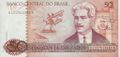 Brazilian 50 cruzados obverse
 -
Olivenkranz


Medical Disclaimer: WikiMD is for informational purposes only and is not a substitute for professional medical advice. Content may be inaccurate or outdated and should not be used for diagnosis or treatment. Always consult your healthcare provider for medical decisions. Verify information with trusted sources such as CDC.gov and NIH.gov. By using this site, you agree that WikiMD is not liable for any outcomes related to its content. See full disclaimer.
Credits:Most images are courtesy of Wikimedia commons, and templates, categories Wikipedia, licensed under CC BY SA or similar.
Translate page: - East Asian
中文,
日本,
한국어,
South Asian
हिन्दी,
தமிழ்,
తెలుగు,
Urdu,
ಕನ್ನಡ,
Southeast Asian
Indonesian,
Vietnamese,
Thai,
မြန်မာဘာသာ,
বাংলা
European
español,
Deutsch,
français,
Greek,
português do Brasil,
polski,
română,
русский,
Nederlands,
norsk,
svenska,
suomi,
Italian
Middle Eastern & African
عربى,
Turkish,
Persian,
Hebrew,
Afrikaans,
isiZulu,
Kiswahili,
Other
Bulgarian,
Hungarian,
Czech,
Swedish,
മലയാളം,
मराठी,
ਪੰਜਾਬੀ,
ગુજરાતી,
Portuguese,
Ukrainian


