Osechi
Osechi are traditional Japanese New Year foods. The tradition started in the Heian Period (794-1185). Osechi are easily recognizable by their special boxes called jubako, which resemble bento boxes. Each dish and ingredient in Osechi has meanings, such as good health, fertility, good harvest, happiness, and longevity.
History[edit]
The tradition of Osechi has its roots in the Heian Period, where it was taboo to use a hearth and cook meals during the first three days of the New Year. Therefore, Osechi was made by the end of the previous year. Over time, the variety of foods prepared for Osechi has increased and it has become a significant event to welcome the New Year.
Components[edit]
Osechi consists of various dishes. Some of the common dishes and their meanings are:
- Kazunoko (herring roe): Symbolizes fertility as herring roe contains many eggs.
- Kuro-mame (black soybeans): Symbolizes health to work hard.
- Tazukuri (candied sardines): Symbolizes a good harvest.
- Kamaboko (fish cake): Alternating slices of pink and white symbolize Japan's rising sun.
- Konbu (seaweed): Symbolizes joy.
Preparation[edit]
Preparing Osechi can be time-consuming. Each dish is often prepared separately and then arranged in the jubako. Many people today buy Osechi from stores due to the complexity of preparation.
Consumption[edit]
Osechi is typically consumed in the first three days of the New Year. It is eaten communally and it is common to invite guests to share in the feast.
See also[edit]
|
This article is part of the series |
|
Japanese cuisine |
|---|
|
Regional cuisines |
|
Ingredients |
|
Preparation and cooking |
|
Utensils |
|
Rituals and festivals |
|
|
| New Year Celebrations | ||||||||
|---|---|---|---|---|---|---|---|---|
This New Year celebrations related article is a stub.
|
| Heian period | ||||||||||
|---|---|---|---|---|---|---|---|---|---|---|
This Heian period related article is a stub.
|

Osechi[edit]


Osechi[edit]
-
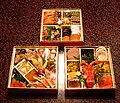 Japanese Osechi
 -
 Japanese Osechi


Medical Disclaimer: WikiMD is for informational purposes only and is not a substitute for professional medical advice. Content may be inaccurate or outdated and should not be used for diagnosis or treatment. Always consult your healthcare provider for medical decisions. Verify information with trusted sources such as CDC.gov and NIH.gov. By using this site, you agree that WikiMD is not liable for any outcomes related to its content. See full disclaimer.
Credits:Most images are courtesy of Wikimedia commons, and templates, categories Wikipedia, licensed under CC BY SA or similar.
Translate page: - East Asian
中文,
日本,
한국어,
South Asian
हिन्दी,
தமிழ்,
తెలుగు,
Urdu,
ಕನ್ನಡ,
Southeast Asian
Indonesian,
Vietnamese,
Thai,
မြန်မာဘာသာ,
বাংলা
European
español,
Deutsch,
français,
Greek,
português do Brasil,
polski,
română,
русский,
Nederlands,
norsk,
svenska,
suomi,
Italian
Middle Eastern & African
عربى,
Turkish,
Persian,
Hebrew,
Afrikaans,
isiZulu,
Kiswahili,
Other
Bulgarian,
Hungarian,
Czech,
Swedish,
മലയാളം,
मराठी,
ਪੰਜਾਬੀ,
ગુજરાતી,
Portuguese,
Ukrainian

