Ornithine decarboxylase
Ornithine Decarboxylase (ODC) is an enzyme that plays a critical role in the polyamine biosynthesis pathway. Polyamines, such as putrescine, spermidine, and spermine, are essential for cell growth and differentiation. The enzyme catalyzes the decarboxylation of ornithine, a amino acid, to produce putrescine, which then serves as a precursor for the other polyamines.
Function[edit]
Ornithine Decarboxylase is pivotal in the polyamine biosynthesis pathway. Polyamines are involved in a variety of cellular processes, including DNA stabilization, gene expression, and ion channel function. By catalyzing the first step in polyamine synthesis, ODC activity is tightly regulated and is a marker for cell proliferation and growth.
Structure[edit]
The structure of Ornithine Decarboxylase is characterized by a pyridoxal phosphate (PLP) binding site, which is essential for its catalytic activity. The enzyme typically functions as a homodimer, and its activity is regulated by antizymes, which inhibit ODC by binding to it and promoting its degradation.
Regulation[edit]
The activity of Ornithine Decarboxylase is regulated at multiple levels, including transcriptional, translational, and post-translational modifications. One of the key regulatory mechanisms is the feedback inhibition by polyamines themselves, which control ODC activity and stability. Additionally, the enzyme is rapidly degraded by the 26S proteasome in a process that does not require ubiquitination, making its half-life extremely short, typically less than an hour.
Clinical Significance[edit]
Aberrant expression of Ornithine Decarboxylase has been implicated in various diseases, including cancer. Elevated levels of ODC and, consequently, polyamines have been observed in several types of tumors, suggesting that ODC may serve as a potential target for cancer therapy. Inhibitors of ODC, such as eflornithine, have been explored for their therapeutic potential in treating cancer and other diseases characterized by excessive cell proliferation.
Inhibitors[edit]
Eflornithine is a well-known inhibitor of Ornithine Decarboxylase. It acts by irreversibly binding to the enzyme, thereby preventing the synthesis of polyamines. Eflornithine has been used in the treatment of hirsutism and is also being investigated for its efficacy in cancer therapy.
See Also[edit]

This WikiMD article can only be edited by registered and verified editors. You can log in or register.
-
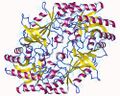 Ornithine decarboxylase structure
 -
 Ornithine decarboxylase mechanism
 -
 Ornithine decarboxylase publication view


Advertise on WikiMD — 81,000+ full articles, ~900,000 total pages, ~250 million page views. Global reach, limited time promotional rates from $1/page/day. Learn more · View stats

Medical Disclaimer: WikiMD is for informational purposes only and is not a substitute for professional medical advice. Content may be inaccurate or outdated and should not be used for diagnosis or treatment. Always consult your healthcare provider for medical decisions. Verify information with trusted sources such as CDC.gov and NIH.gov. By using this site, you agree that WikiMD is not liable for any outcomes related to its content. See full disclaimer.
Credits:Most images are courtesy of Wikimedia commons, and templates, categories Wikipedia, licensed under CC BY SA or similar.
Translate page: - East Asian
中文,
日本,
한국어,
South Asian
हिन्दी,
தமிழ்,
తెలుగు,
Urdu,
ಕನ್ನಡ,
Southeast Asian
Indonesian,
Vietnamese,
Thai,
မြန်မာဘာသာ,
বাংলা
European
español,
Deutsch,
français,
Greek,
português do Brasil,
polski,
română,
русский,
Nederlands,
norsk,
svenska,
suomi,
Italian
Middle Eastern & African
عربى,
Turkish,
Persian,
Hebrew,
Afrikaans,
isiZulu,
Kiswahili,
Other
Bulgarian,
Hungarian,
Czech,
Swedish,
മലയാളം,
मराठी,
ਪੰਜਾਬੀ,
ગુજરાતી,
Portuguese,
Ukrainian

