On the Origin of Species
On the Origin of Species, officially titled On the Origin of Species by Means of Natural Selection, or the Preservation of Favoured Races in the Struggle for Life, is a seminal work in scientific literature written by the English naturalist Charles Darwin. First published on 24 November 1859, the book introduced the theory that populations evolve over the course of generations through a process of natural selection. It presented a body of evidence that the diversity of life arose by common descent through a branching pattern of evolution. Darwin included evidence that he had gathered on the Beagle expedition in the 1830s and his subsequent findings from research, correspondence, and experimentation.
Summary[edit]
The central theme of On the Origin of Species is Darwin's argument that the mechanism of natural selection is the primary cause of evolutionary change. Darwin proposes that species evolve when natural variations within species confer advantages in survival or reproduction, those traits become more common in the population over generations. This process, he argues, has led to the diverse forms of life on Earth. The book is structured around this argument, with the initial chapters outlining the theory and the later chapters providing a wide range of evidence from various fields, including geology, paleontology, and biogeography.
Reception and Impact[edit]
Upon its release, On the Origin of Species was met with a mix of enthusiasm, skepticism, and outright opposition. It challenged the prevailing view of the time that species were unchanging parts of a designed hierarchy and instead suggested that species could change according to natural laws. Over time, Darwin's theory of evolution by natural selection became accepted by the scientific community and the general public as a fundamental concept in biology, influencing not only science but also philosophy, religion, and literature.
Legacy[edit]
Darwin's work laid the foundation for the field of evolutionary biology and transformed the way scientists understand life on Earth. It has been described as one of the most influential books ever written. The theory of evolution by natural selection, with modifications and expansions from subsequent research, remains a central organizing principle in modern biology, providing a unified explanation for the diversity of life.
Editions and Publications[edit]
On the Origin of Species went through six editions during Darwin's lifetime, with various changes and revisions reflecting Darwin's responses to his critics and updates based on new evidence. The book has been translated into multiple languages and remains in print, demonstrating its enduring significance.
See Also[edit]
References[edit]
External Links[edit]
- Darwin Online - Contains various editions of On the Origin of Species and other works by Charles Darwin.

-
 Charles Darwin seated
 -
 Georges Cuvier - Elephant jaw
 -
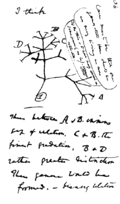 Darwin tree
 -
 Charles Darwin - Pigeon skulls
 -
 Alfred Russel Wallace 1862
 -
 On the Origin of Species by means of natural selection OR the preservation of favoured races in the struggle for life, 2nd edition. By Charles Darwin, John Murray, London, 1860. National Museum of Scotland
 -
 Asa Gray (1867)
 -
 Rhea Darwinii
 -
 Darwin divergence
 -
 Editorial cartoon depicting Charles Darwin as an ape (1871)


.jpg)


.jpg)

Medical Disclaimer: WikiMD is for informational purposes only and is not a substitute for professional medical advice. Content may be inaccurate or outdated and should not be used for diagnosis or treatment. Always consult your healthcare provider for medical decisions. Verify information with trusted sources such as CDC.gov and NIH.gov. By using this site, you agree that WikiMD is not liable for any outcomes related to its content. See full disclaimer.
Credits:Most images are courtesy of Wikimedia commons, and templates, categories Wikipedia, licensed under CC BY SA or similar.
Translate page: - East Asian
中文,
日本,
한국어,
South Asian
हिन्दी,
தமிழ்,
తెలుగు,
Urdu,
ಕನ್ನಡ,
Southeast Asian
Indonesian,
Vietnamese,
Thai,
မြန်မာဘာသာ,
বাংলা
European
español,
Deutsch,
français,
Greek,
português do Brasil,
polski,
română,
русский,
Nederlands,
norsk,
svenska,
suomi,
Italian
Middle Eastern & African
عربى,
Turkish,
Persian,
Hebrew,
Afrikaans,
isiZulu,
Kiswahili,
Other
Bulgarian,
Hungarian,
Czech,
Swedish,
മലയാളം,
मराठी,
ਪੰਜਾਬੀ,
ગુજરાતી,
Portuguese,
Ukrainian

