Oliebol
The Oliebol (plural: oliebollen) is a traditional Dutch and Belgian treat. They are called oil balls in English. The name "oliebol" is a compound of "olie" (oil) and "bol" (ball).
Etymology[edit]
The term "oliebol" is derived from the Dutch words "olie", meaning oil, and "bol", meaning ball. This is a direct reference to the method of preparation, where the dough is deep-fried in oil, and the end product's round shape.
Description[edit]
Oliebollen are a variety of doughnut. They are made by dropping dough into a deep fryer filled with hot oil. In this way, they are similar to the French beignet. The dough is made from flour, eggs, yeast, some salt, milk, baking powder and usually sultanas, currants, raisins and sometimes zest or succade (candied fruit).
History[edit]
Oliebollen are traditionally eaten on New Year's Eve and at funfairs. The dough balls are served with powdered sugar, on a paper plate and eaten hot. The first known recipe dates from 1667. It is a festive food, meant to celebrate the turning of the year and the promise of good fortune and prosperity in the year to come.
Related Terms[edit]
- Beignet: A French doughnut which is a close relative of the oliebol.
- Doughnut: A type of fried dough confectionery or dessert food, similar to the oliebol.
- New Year's Eve: The time when oliebollen are traditionally consumed.
See Also[edit]

This WikiMD article can only be edited by registered and verified editors. You can log in or register.
Oliebol[edit]
-
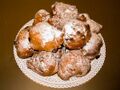 Oliebollen
 -
 Freshly fried oliebollen
 -
 Party For New Year's Day In New Amsterdam 1636 by George Henry Boughton
 -
 Meid met oliebollen, door Aelbert Cuyp


Medical Disclaimer: WikiMD is for informational purposes only and is not a substitute for professional medical advice. Content may be inaccurate or outdated and should not be used for diagnosis or treatment. Always consult your healthcare provider for medical decisions. Verify information with trusted sources such as CDC.gov and NIH.gov. By using this site, you agree that WikiMD is not liable for any outcomes related to its content. See full disclaimer.
Credits:Most images are courtesy of Wikimedia commons, and templates, categories Wikipedia, licensed under CC BY SA or similar.
Translate page: - East Asian
中文,
日本,
한국어,
South Asian
हिन्दी,
தமிழ்,
తెలుగు,
Urdu,
ಕನ್ನಡ,
Southeast Asian
Indonesian,
Vietnamese,
Thai,
မြန်မာဘာသာ,
বাংলা
European
español,
Deutsch,
français,
Greek,
português do Brasil,
polski,
română,
русский,
Nederlands,
norsk,
svenska,
suomi,
Italian
Middle Eastern & African
عربى,
Turkish,
Persian,
Hebrew,
Afrikaans,
isiZulu,
Kiswahili,
Other
Bulgarian,
Hungarian,
Czech,
Swedish,
മലയാളം,
मराठी,
ਪੰਜਾਬੀ,
ગુજરાતી,
Portuguese,
Ukrainian

