Squamous part of occipital bone
The Squamous part of occipital bone is the largest part of the occipital bone, one of the bones that make up the human skull. It is located at the back of the skull, below the parietal bones and above the foramen magnum.
Etymology[edit]
The term "squamous" comes from the Latin word "squama", meaning "scale", which refers to the flat, scale-like appearance of this part of the bone. The term "occipital" comes from the Latin "occiput", which means "back of the skull".
Anatomy[edit]
The squamous part of the occipital bone is marked by a prominent ridge called the external occipital protuberance. Above this feature, the bone is divided into two halves by a groove for the superior sagittal sinus. The halves are called the right and left occipital planes. Below the protuberance, the bone is divided into two halves by the median nuchal line. These halves are called the right and left nuchal planes.
Clinical significance[edit]
The squamous part of the occipital bone is important in clinical medicine because it forms part of the cranial cavity, which houses the brain. It is also the attachment site for several muscles, including the sternocleidomastoid, trapezius, and splenius capitis muscles. Damage to this area can lead to serious neurological problems.
Related terms[edit]
- Occipital bone
- Skull
- Foramen magnum
- External occipital protuberance
- Superior sagittal sinus
- Median nuchal line
- Sternocleidomastoid
- Trapezius
- Splenius capitis

This WikiMD article can only be edited by registered and verified editors. You can log in or register.
-
 Squamous part of occipital bone
 -
 Squama occipitalis
 -
 Squamous part of occipital bone - animation 2
 -
 Squamous part of occipital bone - animation
 -
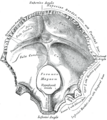 Squamous part of occipital bone


Advertise on WikiMD — 81,000+ full articles, ~900,000 total pages, ~250 million page views. Global reach, limited time promotional rates from $1/page/day. Learn more · View stats


Translate page: - East Asian
中文,
日本,
한국어,
South Asian
हिन्दी,
தமிழ்,
తెలుగు,
Urdu,
ಕನ್ನಡ,
Southeast Asian
Indonesian,
Vietnamese,
Thai,
မြန်မာဘာသာ,
বাংলা
European
español,
Deutsch,
français,
Greek,
português do Brasil,
polski,
română,
русский,
Nederlands,
norsk,
svenska,
suomi,
Italian
Middle Eastern & African
عربى,
Turkish,
Persian,
Hebrew,
Afrikaans,
isiZulu,
Kiswahili,
Other
Bulgarian,
Hungarian,
Czech,
Swedish,
മലയാളം,
मराठी,
ਪੰਜਾਬੀ,
ગુજરાતી,
Portuguese,
Ukrainian
About WikiMD • Contact • Disclaimer • Privacy • Copyright • Site statistics
Some content and images may originate from Wikimedia Commons or Wikipedia and remain subject to their stated licenses. Unless otherwise noted, eligible WikiMD content is available under CC BY-SA 4.0.
WikiMD Wellnesspedia — Free health & wellness information for patients, students, and health professionals.

