Neuroscience of sex differences
Neuroscience of Sex Differences is a subfield of Neuroscience that studies the differences in the brain structures, neurochemicals, and brain functions between males and females. These differences are often influenced by sex hormones, genetics, and environmental factors.
Sex Differences in Brain Structure[edit]
Sex differences in brain structure are evident in both humans and animals. For instance, the hypothalamus, a region of the brain involved in regulating hormones and sexual behavior, is generally larger in males than in females. Similarly, the corpus callosum, which connects the two hemispheres of the brain, is typically larger in females.
Sex Differences in Neurochemistry[edit]
Neurochemical differences between males and females are also evident. For example, males typically have higher levels of dopamine, a neurotransmitter involved in reward and motivation, while females generally have higher levels of serotonin, a neurotransmitter involved in mood regulation.
Sex Differences in Brain Function[edit]
Sex differences in brain function can be observed in various cognitive and emotional tasks. For instance, males tend to perform better on spatial tasks, while females tend to perform better on verbal tasks. Additionally, females are generally more responsive to emotional stimuli than males.
Influence of Sex Hormones[edit]
Sex hormones, such as estrogen and testosterone, play a crucial role in shaping the sex differences in the brain. These hormones can influence the development and function of various brain regions, thereby contributing to the observed sex differences in brain structure, neurochemistry, and function.
Influence of Genetics[edit]
Genetics also play a role in the sex differences in the brain. For instance, genes located on the sex chromosomes can influence the development and function of the brain, thereby contributing to the observed sex differences.
Influence of Environmental Factors[edit]
Environmental factors, such as stress and exposure to toxins, can also influence the sex differences in the brain. These factors can interact with genetics and hormones to shape the brain's development and function.
See Also[edit]
References[edit]

-
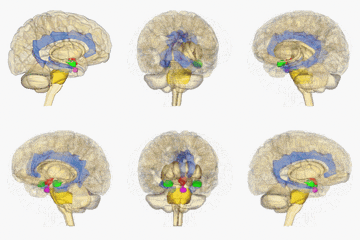 Neuroscience of sex differences
 -
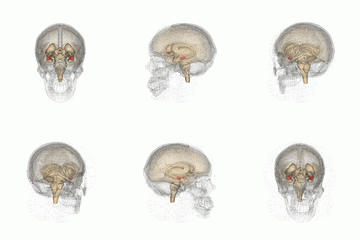 Neuroscience of sex differences


Medical Disclaimer: WikiMD is for informational purposes only and is not a substitute for professional medical advice. Content may be inaccurate or outdated and should not be used for diagnosis or treatment. Always consult your healthcare provider for medical decisions. Verify information with trusted sources such as CDC.gov and NIH.gov. By using this site, you agree that WikiMD is not liable for any outcomes related to its content. See full disclaimer.
Credits:Most images are courtesy of Wikimedia commons, and templates, categories Wikipedia, licensed under CC BY SA or similar.
Translate page: - East Asian
中文,
日本,
한국어,
South Asian
हिन्दी,
தமிழ்,
తెలుగు,
Urdu,
ಕನ್ನಡ,
Southeast Asian
Indonesian,
Vietnamese,
Thai,
မြန်မာဘာသာ,
বাংলা
European
español,
Deutsch,
français,
Greek,
português do Brasil,
polski,
română,
русский,
Nederlands,
norsk,
svenska,
suomi,
Italian
Middle Eastern & African
عربى,
Turkish,
Persian,
Hebrew,
Afrikaans,
isiZulu,
Kiswahili,
Other
Bulgarian,
Hungarian,
Czech,
Swedish,
മലയാളം,
मराठी,
ਪੰਜਾਬੀ,
ગુજરાતી,
Portuguese,
Ukrainian

