Moscovium
Moscovium (IUPAC chemical nomenclature: Mc) is a synthetic chemical element with the symbol Mc and atomic number 115. It is an extremely radioactive element, and its most stable known isotope, moscovium-290, has a half-life of only about 0.65 seconds. Moscovium was first synthesized in 2003 by a joint team of Russian and American scientists at the Joint Institute for Nuclear Research (JINR) in Dubna, Russia, and the Lawrence Livermore National Laboratory (LLNL) in California, USA. The element was named after the Moscow Oblast, where Dubna is located.
Properties[edit]
Moscovium is expected to be a heavy, highly radioactive metal with physical and chemical properties similar to its lighter homologues in the group 15 of the periodic table, such as bismuth. Due to its instability and radioactivity, comprehensive studies of moscovium have not been possible, and most of its predicted properties are theoretical.
Synthesis and Isotopes[edit]
Moscovium is synthesized in particle accelerators by bombarding atoms of americium (Am) with ions of calcium (Ca). The most common reaction used to produce moscovium is: \[ \text{^{243}_{95}Am} + \text{^{48}_{20}Ca} \rightarrow \text{^{291}_{115}Mc} + 0n \] This reaction occasionally produces moscovium-291, but more often, isotopes with a smaller mass number are created due to the emission of neutrons during the reaction.
Decay[edit]
Moscovium isotopes are highly unstable and decay rapidly into lighter elements. Moscovium-290, for example, decays into nihonium-286 through alpha decay.
Naming and Discovery[edit]
The discovery of moscovium was officially reported in 2004 by a team of scientists from JINR and LLNL. The name "moscovium" was adopted by the International Union of Pure and Applied Chemistry (IUPAC) in 2016, honoring the Moscow region and its significant contribution to the field of nuclear research.
Applications[edit]
Due to its short half-life and the difficulty in producing moscovium, practical applications are currently non-existent. Its study is primarily of scientific interest, particularly in the fields of nuclear physics and the chemistry of superheavy elements.
See Also[edit]
References[edit]

This chemical element related article is a stub. You can help WikiMD by expanding it.
-
 Red Square
 -
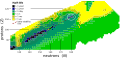 Island of Stability
.jpg)


Medical Disclaimer: WikiMD is for informational purposes only and is not a substitute for professional medical advice. Content may be inaccurate or outdated and should not be used for diagnosis or treatment. Always consult your healthcare provider for medical decisions. Verify information with trusted sources such as CDC.gov and NIH.gov. By using this site, you agree that WikiMD is not liable for any outcomes related to its content. See full disclaimer.
Credits:Most images are courtesy of Wikimedia commons, and templates, categories Wikipedia, licensed under CC BY SA or similar.
Translate page: - East Asian
中文,
日本,
한국어,
South Asian
हिन्दी,
தமிழ்,
తెలుగు,
Urdu,
ಕನ್ನಡ,
Southeast Asian
Indonesian,
Vietnamese,
Thai,
မြန်မာဘာသာ,
বাংলা
European
español,
Deutsch,
français,
Greek,
português do Brasil,
polski,
română,
русский,
Nederlands,
norsk,
svenska,
suomi,
Italian
Middle Eastern & African
عربى,
Turkish,
Persian,
Hebrew,
Afrikaans,
isiZulu,
Kiswahili,
Other
Bulgarian,
Hungarian,
Czech,
Swedish,
മലയാളം,
मराठी,
ਪੰਜਾਬੀ,
ગુજરાતી,
Portuguese,
Ukrainian

