Microbiological culture
Microbiological culture is a method used in microbiology to multiply microorganisms by letting them reproduce in predetermined culture media under controlled laboratory conditions. It is one of the primary diagnostic methods in microbiology used to isolate and identify the different types of microorganisms.
History[edit]
The concept of microbiological culture was first proposed by Robert Koch, a German physician and microbiologist. He developed the technique in the late 19th century as a way to isolate bacteria and study them in pure culture.
Types of Microbiological Culture[edit]
There are several types of microbiological cultures used for different purposes. These include:
- Pure culture: A culture in which only one type of microorganism is grown.
- Mixed culture: A culture that contains two or more types of microorganisms.
- Enrichment culture: A culture medium with specific nutrients added to favor the growth of a particular microorganism.
- Selective culture: A culture medium designed to suppress the growth of unwanted microorganisms and encourage the growth of desired ones.
Culture Media[edit]
The culture media used in microbiological culture are of several types, including:
- Agar plates: Solid culture media made from a gelatinous substance derived from seaweed.
- Broth cultures: Liquid culture media used for growing microorganisms like bacteria and fungi.
- Semi-solid media: Used for the detection of bacterial motility.
Applications[edit]
Microbiological culture has a wide range of applications in various fields such as medicine, pharmaceuticals, agriculture, and food industry. It is used for the isolation and identification of pathogens, production of antibiotics, and testing the effectiveness of antimicrobial agents.
See Also[edit]

This WikiMD article can only be edited by registered and verified editors. You can log in or register.
 | This science article is a stub. You can help WikiMD by expanding the page. |
-
 Microbial cultures in a fridge
 -
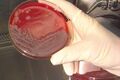 Anthrax culture
 -
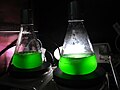 Synechococcus cyanobacteria cultures
 -
Diagnostic algorithm of possible bacterial infection
-
 Multitarget microbial panel for MicroScan WalkAway system
 -
 BD Phoenix M50 automated microbiology system
 -
 Working with a bacteriological analyzer
 -
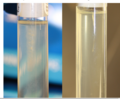 Stab culture


.jpg)

Advertise on WikiMD — 81,000+ full articles, ~900,000 total pages, ~250 million page views. Global reach, limited time promotional rates from $1/page/day. Learn more · View stats

Medical Disclaimer: WikiMD is for informational purposes only and is not a substitute for professional medical advice. Content may be inaccurate or outdated and should not be used for diagnosis or treatment. Always consult your healthcare provider for medical decisions. Verify information with trusted sources such as CDC.gov and NIH.gov. By using this site, you agree that WikiMD is not liable for any outcomes related to its content. See full disclaimer.
Credits:Most images are courtesy of Wikimedia commons, and templates, categories Wikipedia, licensed under CC BY SA or similar.
Translate page: - East Asian
中文,
日本,
한국어,
South Asian
हिन्दी,
தமிழ்,
తెలుగు,
Urdu,
ಕನ್ನಡ,
Southeast Asian
Indonesian,
Vietnamese,
Thai,
မြန်မာဘာသာ,
বাংলা
European
español,
Deutsch,
français,
Greek,
português do Brasil,
polski,
română,
русский,
Nederlands,
norsk,
svenska,
suomi,
Italian
Middle Eastern & African
عربى,
Turkish,
Persian,
Hebrew,
Afrikaans,
isiZulu,
Kiswahili,
Other
Bulgarian,
Hungarian,
Czech,
Swedish,
മലയാളം,
मराठी,
ਪੰਜਾਬੀ,
ગુજરાતી,
Portuguese,
Ukrainian


