Medicare Part D
Medicare Part D is a program that provides prescription drug coverage for people who are eligible for Medicare in the United States. It was enacted as part of the Medicare Modernization Act of 2003 and went into effect on January 1, 2006.
Overview[edit]
Medicare Part D is optional and is offered by private insurance companies that are approved by Medicare. The program is designed to help people with Medicare pay for prescription drugs, including vaccines, biologicals, and certain medical supplies that are not covered by Medicare Part B.
Eligibility[edit]
To be eligible for Medicare Part D, an individual must be entitled to benefits under Medicare Part A and/or enrolled in Medicare Part B. The individual must also live in the service area of a Medicare Part D Pharmacy Benefit Manager (PBM).
Coverage[edit]
Medicare Part D coverage varies by plan, but all plans must cover at least a standard level of coverage set by Medicare. The standard benefit includes an initial coverage limit followed by a coverage gap (also known as the "donut hole"), catastrophic coverage, and a monthly premium.
Costs[edit]
The costs for Medicare Part D include a monthly premium, yearly deductible, copayments or coinsurance, and costs in the coverage gap. Some people may qualify for Extra Help, a program to help pay for these costs.
Enrollment[edit]
Enrollment in Medicare Part D is voluntary and is available during specific times of the year, known as enrollment periods. There are also special enrollment periods for certain situations.
Criticisms[edit]
Medicare Part D has been criticized for its complexity, the coverage gap, and the high costs of prescription drugs.
See also[edit]
- Medicare (United States)
- Medicare Part A
- Medicare Part B
- Medicare Modernization Act
- Prescription drug

This WikiMD article can only be edited by registered and verified editors. You can log in or register.
Medicare Part D[edit]
-
 Centers for Medicare and Medicaid Services logo
 -
 Part D Standard Benefit 2021
 -
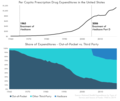 United States Per Capita Prescription Drug Expenditures, 1960-2019


Sponsored Health Resource

W8MD Weight Loss, Sleep & MedSpa
Looking for physician-supervised weight loss, semaglutide, tirzepatide, or GLP-1 receptor agonist options? W8MD helps eligible patients in New York City, Brooklyn, New Jersey, Connecticut, Pennsylvania, Delaware, and greater Philadelphia with medical weight loss, sleep medicine, and long-term maintenance support.
GLP-1 specials: Affordable GLP-1 injections NYC and Philadelphia starting from $29.99/week and up for semaglutide with insurance accepted for qualifying visits, and $45/week and up for tirzepatide with insurance accepted for qualifying visits. Self-pay options start from $59.99/week and up for semaglutide and $69.99/week and up for tirzepatide.
Medical weight loss NYC | Affordable GLP-1 injections NYC | Budget GLP-1 weight loss shots Philadelphia | New Jersey medical weight loss | NYC medical weight loss | Philadelphia medical weight loss | Sleep clinic NYC | W8MD's Philadelphia GLP-1 doctor | Weight loss prescriptions NYC
Book a W8MD appointment · View GLP-1 specials
Paid promotional message. Eligibility, pricing, insurance coverage, medication availability, and results vary. Medical evaluation required.

Medical Disclaimer: WikiMD is for informational purposes only and is not a substitute for professional medical advice. Content may be inaccurate or outdated and should not be used for diagnosis or treatment. Always consult your healthcare provider for medical decisions. Verify information with trusted sources such as CDC.gov and NIH.gov. By using this site, you agree that WikiMD is not liable for any outcomes related to its content. See full disclaimer.
Credits:Most images are courtesy of Wikimedia commons, and templates, categories Wikipedia, licensed under CC BY SA or similar.
Translate page: - East Asian
中文,
日本,
한국어,
South Asian
हिन्दी,
தமிழ்,
తెలుగు,
Urdu,
ಕನ್ನಡ,
Southeast Asian
Indonesian,
Vietnamese,
Thai,
မြန်မာဘာသာ,
বাংলা
European
español,
Deutsch,
français,
Greek,
português do Brasil,
polski,
română,
русский,
Nederlands,
norsk,
svenska,
suomi,
Italian
Middle Eastern & African
عربى,
Turkish,
Persian,
Hebrew,
Afrikaans,
isiZulu,
Kiswahili,
Other
Bulgarian,
Hungarian,
Czech,
Swedish,
മലയാളം,
मराठी,
ਪੰਜਾਬੀ,
ગુજરાતી,
Portuguese,
Ukrainian

