Mastoid foramen
Mastoid foramen is a small opening in the skull that allows for the passage of blood vessels and nerves. It is located in the mastoid process, a bony prominence behind the ear. The mastoid foramen is an important anatomical landmark in surgeries involving the ear and the surrounding structures.
Etymology[edit]
The term "mastoid" is derived from the Greek word "mastoeides", which means "breast-like". This is in reference to the shape of the mastoid process, which resembles a breast or nipple. The term "foramen" is derived from the Latin word "forare", which means "to bore" or "to pierce". This is in reference to the hole-like nature of the foramen.
Anatomy[edit]
The mastoid foramen is located on the outer surface of the mastoid process. It is usually situated near the posterior border of the temporal bone, close to the occipital bone. The foramen allows for the passage of the mastoid emissary vein, which connects the posterior auricular vein and the sigmoid sinus. It also allows for the passage of the mastoid branch of the occipital artery, a small meningeal branch of the vagus nerve, and sometimes the mastoid branch of the posterior auricular nerve.
Clinical significance[edit]
The mastoid foramen is an important landmark in surgeries involving the ear, such as mastoidectomy, a surgical procedure to remove diseased mastoid air cells. The foramen's location can vary, and it can sometimes be difficult to locate during surgery. Knowledge of its typical location and variations can help surgeons avoid damaging the structures that pass through it.
Related terms[edit]
- Mastoid process: The bony prominence behind the ear where the mastoid foramen is located.
- Temporal bone: The bone in the skull where the mastoid process and mastoid foramen are located.
- Occipital bone: The bone in the skull located near the mastoid foramen.
- Mastoidectomy: A surgical procedure to remove diseased mastoid air cells.

This WikiMD article can only be edited by registered and verified editors. You can log in or register.
-
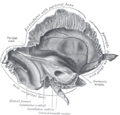 Gray's Anatomy Plate 138
 -
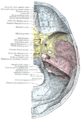 Gray's Anatomy Plate 193


Medical Disclaimer: WikiMD is for informational purposes only and is not a substitute for professional medical advice. Content may be inaccurate or outdated and should not be used for diagnosis or treatment. Always consult your healthcare provider for medical decisions. Verify information with trusted sources such as CDC.gov and NIH.gov. By using this site, you agree that WikiMD is not liable for any outcomes related to its content. See full disclaimer.
Credits:Most images are courtesy of Wikimedia commons, and templates, categories Wikipedia, licensed under CC BY SA or similar.
Translate page: - East Asian
中文,
日本,
한국어,
South Asian
हिन्दी,
தமிழ்,
తెలుగు,
Urdu,
ಕನ್ನಡ,
Southeast Asian
Indonesian,
Vietnamese,
Thai,
မြန်မာဘာသာ,
বাংলা
European
español,
Deutsch,
français,
Greek,
português do Brasil,
polski,
română,
русский,
Nederlands,
norsk,
svenska,
suomi,
Italian
Middle Eastern & African
عربى,
Turkish,
Persian,
Hebrew,
Afrikaans,
isiZulu,
Kiswahili,
Other
Bulgarian,
Hungarian,
Czech,
Swedish,
മലയാളം,
मराठी,
ਪੰਜਾਬੀ,
ગુજરાતી,
Portuguese,
Ukrainian

