Mannitol hexanitrate
Mannitol hexanitrate is a powerful explosive that is derived from mannitol, a type of sugar alcohol. It is a high explosive that is often used in military applications, particularly in the production of detonators and blasting caps.
History[edit]
Mannitol hexanitrate was first synthesized in the late 19th century. It was initially used as a medicinal compound due to its vasodilatory properties. However, its explosive properties were soon discovered and it began to be used in military applications.
Properties[edit]
Mannitol hexanitrate is a white crystalline solid. It is highly sensitive to shock, friction, and heat, which can cause it to explode. It has a high detonation velocity and is capable of producing a powerful explosion.
Synthesis[edit]
Mannitol hexanitrate is synthesized by nitrating mannitol with a mixture of concentrated nitric acid and sulfuric acid. The reaction is highly exothermic and must be carefully controlled to prevent an explosion.
Uses[edit]
Mannitol hexanitrate is primarily used as an explosive. It is often used in the production of detonators and blasting caps. It can also be used as a vasodilator in medical applications, although this use is less common due to the risk of explosion.
Safety[edit]
Due to its high sensitivity to shock, friction, and heat, mannitol hexanitrate must be handled with extreme care. It should be stored in a cool, dry place away from sources of ignition.
See also[edit]

-
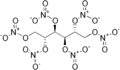 Nitromannite


Medical Disclaimer: WikiMD is for informational purposes only and is not a substitute for professional medical advice. Content may be inaccurate or outdated and should not be used for diagnosis or treatment. Always consult your healthcare provider for medical decisions. Verify information with trusted sources such as CDC.gov and NIH.gov. By using this site, you agree that WikiMD is not liable for any outcomes related to its content. See full disclaimer.
Credits:Most images are courtesy of Wikimedia commons, and templates, categories Wikipedia, licensed under CC BY SA or similar.
Translate page: - East Asian
中文,
日本,
한국어,
South Asian
हिन्दी,
தமிழ்,
తెలుగు,
Urdu,
ಕನ್ನಡ,
Southeast Asian
Indonesian,
Vietnamese,
Thai,
မြန်မာဘာသာ,
বাংলা
European
español,
Deutsch,
français,
Greek,
português do Brasil,
polski,
română,
русский,
Nederlands,
norsk,
svenska,
suomi,
Italian
Middle Eastern & African
عربى,
Turkish,
Persian,
Hebrew,
Afrikaans,
isiZulu,
Kiswahili,
Other
Bulgarian,
Hungarian,
Czech,
Swedish,
മലയാളം,
मराठी,
ਪੰਜਾਬੀ,
ગુજરાતી,
Portuguese,
Ukrainian

