Mad2
Mad2 is a protein that in humans is encoded by the MAD2L1 gene. It is a crucial component of the mitotic checkpoint, which serves as a regulatory mechanism to ensure proper chromosome segregation during cell division.
Function[edit]
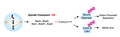
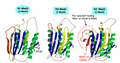
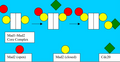
Mad2 is a key player in the spindle assembly checkpoint (SAC), a surveillance mechanism that maintains genome stability by preventing anaphase onset until all chromosomes are properly attached to the mitotic spindle. Mad2 can exist in two conformations: open (O-Mad2) and closed (C-Mad2). The conversion from O-Mad2 to C-Mad2 is facilitated by the Mad1-Mad2 core complex, a process that is essential for the checkpoint signal.
Clinical significance[edit]
Alterations in the function of Mad2 have been linked to various forms of cancer. Overexpression of Mad2, which can lead to chromosome instability, has been observed in several types of cancer, including lung cancer, ovarian cancer, and colorectal cancer. On the other hand, loss of Mad2 function can also contribute to tumorigenesis by allowing cells with abnormal chromosome numbers to proliferate.
Interactions[edit]
Mad2 has been shown to interact with various proteins, including CDC20, BUB1B, and TTK protein kinase. These interactions are crucial for the function of the spindle assembly checkpoint.
See also[edit]
References[edit]
 | This medical article is a stub. You can help WikiMD by expanding the page. |
-
 Mad2
Mad2 -
 Mad2
Mad2 -
 Mad2
Mad2


Medical Disclaimer: WikiMD is for informational purposes only and is not a substitute for professional medical advice. Content may be inaccurate or outdated and should not be used for diagnosis or treatment. Always consult your healthcare provider for medical decisions. Verify information with trusted sources such as CDC.gov and NIH.gov. By using this site, you agree that WikiMD is not liable for any outcomes related to its content. See full disclaimer.
Credits:Most images are courtesy of Wikimedia commons, and templates, categories Wikipedia, licensed under CC BY SA or similar.
Translate page: - East Asian
中文,
日本,
한국어,
South Asian
हिन्दी,
தமிழ்,
తెలుగు,
Urdu,
ಕನ್ನಡ,
Southeast Asian
Indonesian,
Vietnamese,
Thai,
မြန်မာဘာသာ,
বাংলা
European
español,
Deutsch,
français,
Greek,
português do Brasil,
polski,
română,
русский,
Nederlands,
norsk,
svenska,
suomi,
Italian
Middle Eastern & African
عربى,
Turkish,
Persian,
Hebrew,
Afrikaans,
isiZulu,
Kiswahili,
Other
Bulgarian,
Hungarian,
Czech,
Swedish,
മലയാളം,
मराठी,
ਪੰਜਾਬੀ,
ગુજરાતી,
Portuguese,
Ukrainian

