Long-chain-fatty-acid—CoA ligase
Long-chain-fatty-acid—CoA ligase (LCFACL) is an enzyme that plays a crucial role in lipid metabolism by catalyzing the conversion of long-chain fatty acids into their active form, long-chain fatty acyl-CoA. This process is essential for the synthesis and degradation of lipids, including the storage of energy and the construction of cellular membranes.
Function[edit]
Long-chain-fatty-acid—CoA ligase is involved in the first step of the fatty acid metabolism pathway, activating long-chain fatty acids. This activation is necessary for various metabolic processes, including beta-oxidation, where fatty acids are broken down to produce energy, and the synthesis of lipids such as phospholipids, cholesterol esters, and triglycerides. The enzyme works by catalyzing the reaction of a long-chain fatty acid with Coenzyme A (CoA) and ATP, to produce long-chain fatty acyl-CoA, AMP, and pyrophosphate.
Structure[edit]
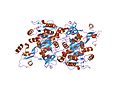
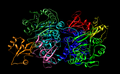
The enzyme belongs to the family of ligases, specifically those forming carbon-sulfur bonds as acid-thiol ligases. The structure of long-chain-fatty-acid—CoA ligase includes domains for binding ATP, CoA, and the long-chain fatty acid substrate. The active site of the enzyme is where the catalysis of the fatty acid to its CoA derivative occurs.
Clinical Significance[edit]
Alterations in the activity of long-chain-fatty-acid—CoA ligase can have significant metabolic consequences. Deficiencies in this enzyme have been linked to various metabolic disorders, including fatty acid metabolism disorders and mitochondrial diseases. These conditions can lead to symptoms such as muscle weakness, cardiomyopathy, and hypoglycemia due to the impaired ability of the body to utilize long-chain fatty acids for energy.
Genetic Regulation[edit]
The expression of the gene encoding long-chain-fatty-acid—CoA ligase is regulated by nutritional and hormonal factors. Insulin, for example, upregulates the expression of this enzyme, facilitating lipid synthesis and storage. Conversely, fasting downregulates its expression, promoting the mobilization of fatty acids for energy production.
See Also[edit]
References[edit]
 | This enzyme-related article is a stub. You can help WikiMD by expanding the page. |
-
 Long-chain-fatty-acid—CoA_ligase
 -
 Long-chain-fatty-acid—CoA_ligase
 -
 Long-chain-fatty-acid—CoA_ligase
 -
 Long-chain-fatty-acid—CoA_ligase
 -
 Long-chain-fatty-acid—CoA_ligase
 -
 Long-chain-fatty-acid—CoA_ligase
 -
 Long-chain-fatty-acid—CoA_ligase


Medical Disclaimer: WikiMD is for informational purposes only and is not a substitute for professional medical advice. Content may be inaccurate or outdated and should not be used for diagnosis or treatment. Always consult your healthcare provider for medical decisions. Verify information with trusted sources such as CDC.gov and NIH.gov. By using this site, you agree that WikiMD is not liable for any outcomes related to its content. See full disclaimer.
Credits:Most images are courtesy of Wikimedia commons, and templates, categories Wikipedia, licensed under CC BY SA or similar.
Translate page: - East Asian
中文,
日本,
한국어,
South Asian
हिन्दी,
தமிழ்,
తెలుగు,
Urdu,
ಕನ್ನಡ,
Southeast Asian
Indonesian,
Vietnamese,
Thai,
မြန်မာဘာသာ,
বাংলা
European
español,
Deutsch,
français,
Greek,
português do Brasil,
polski,
română,
русский,
Nederlands,
norsk,
svenska,
suomi,
Italian
Middle Eastern & African
عربى,
Turkish,
Persian,
Hebrew,
Afrikaans,
isiZulu,
Kiswahili,
Other
Bulgarian,
Hungarian,
Czech,
Swedish,
മലയാളം,
मराठी,
ਪੰਜਾਬੀ,
ગુજરાતી,
Portuguese,
Ukrainian

