List of instruments used in forensics
Forensic science is a critical aspect of the criminal justice system, providing the necessary scientific analysis to solve crimes, identify suspects, and exonerate the innocent. The field of forensics utilizes a wide range of instruments and tools to collect, analyze, and interpret evidence. This article provides an overview of the key instruments used in forensic investigations.
Microscopes[edit]
Microscopes are indispensable in forensic science for analyzing evidence that is too small to be seen with the naked eye. Different types of microscopes used include:
- Compound microscope: Used for viewing small or thinly sliced sections of objects under high magnification.
- Comparison microscope: Allows the side-by-side comparison of samples, such as fibers or hair.
- Electron microscope: Provides very high magnification and resolution, used for examining extremely small particles.
Spectrophotometers[edit]
Spectrophotometers measure the amount of light that a chemical substance absorbs. They are used in forensics for analyzing substances such as drugs, blood, and other bodily fluids. Types include:
- UV-Visible spectrophotometer: Used for analyzing colorless substances.
- Infrared spectrophotometer: Useful for identifying and analyzing substances based on their infrared spectra.
Chromatographs[edit]
Chromatography is a method for separating mixtures. In forensics, it is used for analyzing complex mixtures like blood, ink, and drugs. Types include:
- Gas chromatography (GC): Separates and analyzes compounds that can be vaporized without decomposition.
- High-performance liquid chromatography (HPLC): Used for separating the components in a mixture for further analysis.
DNA Sequencers[edit]
DNA sequencers are used in forensic science for analyzing DNA samples to identify individuals. The process involves extracting DNA, amplifying it, and then sequencing it to create a DNA profile.
Fingerprint Analysis Tools[edit]
Fingerprint analysis is a fundamental part of forensic investigations. Tools used include:
- Fingerprint powders and brushes: For dusting surfaces to reveal latent fingerprints.
- Fuming chambers: Used for developing fingerprints on non-porous surfaces.
- AFIS (Automated Fingerprint Identification System): A computerized system for storing, retrieving, and analyzing fingerprint data.
Toxicology Analysis Instruments[edit]
Toxicology in forensics involves the study of toxic substances, drugs, and their effects on the human body. Instruments used include:
- Gas chromatography-mass spectrometry (GC-MS): Combines the features of gas chromatography and mass spectrometry to identify different substances within a test sample.
- Liquid chromatography-mass spectrometry (LC-MS): Similar to GC-MS but used for substances that are less volatile.
Ballistics Tools[edit]
In forensic ballistics, experts analyze firearms, bullets, and bullet impacts to determine information about crimes. Tools include:
- Ballistic fingerprinting: The process of analyzing the unique marks left on a bullet or cartridge case.
- Trajectory analysis tools: Used for determining the trajectory of bullets and reconstructing shooting scenes.
Digital Forensics Tools[edit]
Digital forensics involves the recovery and investigation of material found in digital devices. Tools and software used include:
- EnCase: A forensic tool for imaging and examining data from various types of digital media.
- FTK (Forensic Toolkit): A digital forensics software used to scan a hard drive looking for various information.
Conclusion[edit]
The instruments used in forensic science are vital for the accurate and reliable analysis of evidence. These tools enable forensic experts to piece together evidence and contribute to the administration of justice.
 | This law-related article is a stub. You can help WikiMD by expanding the page. |
-
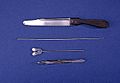 Autopsy instruments
 -
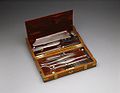 Autopsy instruments old set
 -
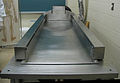 Cadaver dissection table - long shot


Sponsored Health Resource

W8MD Weight Loss, Sleep & MedSpa
Looking for physician-supervised weight loss, semaglutide, tirzepatide, or GLP-1 receptor agonist options? W8MD helps eligible patients in New York City, Brooklyn, New Jersey, Connecticut, Pennsylvania, Delaware, and greater Philadelphia with medical weight loss, sleep medicine, and long-term maintenance support.
GLP-1 specials: Affordable GLP-1 injections NYC and Philadelphia starting from $29.99/week and up for semaglutide with insurance accepted for qualifying visits, and $45/week and up for tirzepatide with insurance accepted for qualifying visits. Self-pay options start from $59.99/week and up for semaglutide and $69.99/week and up for tirzepatide.
Medical weight loss NYC | Affordable GLP-1 injections NYC | Budget GLP-1 weight loss shots Philadelphia | New Jersey medical weight loss | NYC medical weight loss | Philadelphia medical weight loss | Sleep clinic NYC | W8MD's Philadelphia GLP-1 doctor | Weight loss prescriptions NYC
Book a W8MD appointment · View GLP-1 specials
Paid promotional message. Eligibility, pricing, insurance coverage, medication availability, and results vary. Medical evaluation required.

Medical Disclaimer: WikiMD is for informational purposes only and is not a substitute for professional medical advice. Content may be inaccurate or outdated and should not be used for diagnosis or treatment. Always consult your healthcare provider for medical decisions. Verify information with trusted sources such as CDC.gov and NIH.gov. By using this site, you agree that WikiMD is not liable for any outcomes related to its content. See full disclaimer.
Credits:Most images are courtesy of Wikimedia commons, and templates, categories Wikipedia, licensed under CC BY SA or similar.
Translate page: - East Asian
中文,
日本,
한국어,
South Asian
हिन्दी,
தமிழ்,
తెలుగు,
Urdu,
ಕನ್ನಡ,
Southeast Asian
Indonesian,
Vietnamese,
Thai,
မြန်မာဘာသာ,
বাংলা
European
español,
Deutsch,
français,
Greek,
português do Brasil,
polski,
română,
русский,
Nederlands,
norsk,
svenska,
suomi,
Italian
Middle Eastern & African
عربى,
Turkish,
Persian,
Hebrew,
Afrikaans,
isiZulu,
Kiswahili,
Other
Bulgarian,
Hungarian,
Czech,
Swedish,
മലയാളം,
मराठी,
ਪੰਜਾਬੀ,
ગુજરાતી,
Portuguese,
Ukrainian

