List of WHO regions
The World Health Organization (WHO) is a specialized agency of the United Nations responsible for international public health. The WHO was established on 7 April 1948. Its headquarters are located in Geneva, Switzerland. The organization is divided into regions, each with its own regional office. These regions are a fundamental aspect of WHO's structure, allowing for a more localized approach to public health issues. This article provides an overview of the WHO regions, including their respective countries and territories.
WHO Regions[edit]
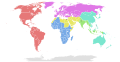
The World Health Organization divides the world into six regions, each with its own regional office. These regions are:
African Region (AFRO)[edit]
The African Region covers the majority of the African continent. It is one of the largest WHO regions in terms of the number of countries. The regional office for Africa is located in Brazzaville, Congo.
Region of the Americas (PAHO)[edit]
The Region of the Americas, also known as the Pan American Health Organization (PAHO), includes countries in North, South, and Central America, as well as the Caribbean. The regional office is in Washington, D.C., United States.
South-East Asia Region (SEARO)[edit]
The South-East Asia Region includes countries located on the Indian subcontinent and nearby areas. The regional office for South-East Asia is in New Delhi, India.
European Region (EURO)[edit]
The European Region encompasses countries in Europe, as well as Israel. The regional office for Europe is in Copenhagen, Denmark.
Eastern Mediterranean Region (EMRO)[edit]
The Eastern Mediterranean Region includes countries in the Middle East, North Africa, and the Horn of Africa. The regional office is in Cairo, Egypt.
Western Pacific Region (WPRO)[edit]
The Western Pacific Region covers countries in East Asia, Southeast Asia, Australasia, and the Pacific. The regional office for the Western Pacific is in Manila, Philippines.
Purpose and Activities[edit]
Each WHO region works towards the organization's overarching goal of building a better, healthier future for people all over the world. They do this by monitoring public health risks, promoting health and well-being, and coordinating responses to health emergencies. Regional offices play a crucial role in tailoring WHO's global initiatives to fit the specific needs of their respective regions.
Challenges and Criticisms[edit]
While the regional structure allows for a more localized approach to health issues, it has also faced criticism. Challenges include disparities in health conditions and resources among countries within the same region, as well as differences in the effectiveness of regional offices.
See Also[edit]
This list is incomplete; you can help WikiMD by expanding it.
-
 List of WHO regions

Advertise on WikiMD — 81,000+ full articles, ~900,000 total pages, ~250 million page views. Global reach, limited time promotional rates from $1/page/day. Learn more · View stats

Medical Disclaimer: WikiMD is for informational purposes only and is not a substitute for professional medical advice. Content may be inaccurate or outdated and should not be used for diagnosis or treatment. Always consult your healthcare provider for medical decisions. Verify information with trusted sources such as CDC.gov and NIH.gov. By using this site, you agree that WikiMD is not liable for any outcomes related to its content. See full disclaimer.
Credits:Most images are courtesy of Wikimedia commons, and templates, categories Wikipedia, licensed under CC BY SA or similar.
Translate page: - East Asian
中文,
日本,
한국어,
South Asian
हिन्दी,
தமிழ்,
తెలుగు,
Urdu,
ಕನ್ನಡ,
Southeast Asian
Indonesian,
Vietnamese,
Thai,
မြန်မာဘာသာ,
বাংলা
European
español,
Deutsch,
français,
Greek,
português do Brasil,
polski,
română,
русский,
Nederlands,
norsk,
svenska,
suomi,
Italian
Middle Eastern & African
عربى,
Turkish,
Persian,
Hebrew,
Afrikaans,
isiZulu,
Kiswahili,
Other
Bulgarian,
Hungarian,
Czech,
Swedish,
മലയാളം,
मराठी,
ਪੰਜਾਬੀ,
ગુજરાતી,
Portuguese,
Ukrainian

