Lingual veins

Veins located under the tongue
Blood vessels
[[File: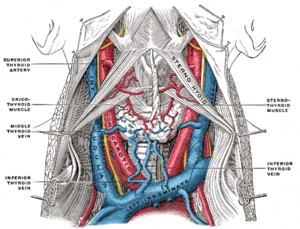 |frameless|alt=]]

| Details | |
|---|---|
| Synonyms | |
| Pronunciation | |
| Carnegie stage | |
| Days | |
| Precursor | |
| Gives rise to | |
| Part of | |
The lingual veins are a group of veins located under the tongue that are responsible for draining blood from the tongue and the floor of the mouth. These veins are part of the circulatory system and play a crucial role in the venous drainage of the tongue.
Anatomy[edit]
The lingual veins are typically divided into three main branches:
- The deep lingual vein (also known as the vena comitans nervi hypoglossi) runs alongside the hypoglossal nerve and drains the deep structures of the tongue.
- The dorsal lingual veins drain the dorsal surface of the tongue.
- The sublingual vein drains the floor of the mouth and the sublingual gland.
These veins converge and eventually drain into the internal jugular vein, which is a major vein in the neck that returns deoxygenated blood from the head to the heart.
Function[edit]
The primary function of the lingual veins is to drain deoxygenated blood from the tongue and the floor of the mouth. This is essential for maintaining proper blood circulation and ensuring that metabolic waste products are efficiently removed from these tissues.
Clinical significance[edit]
The lingual veins can be observed during a physical examination of the mouth and are often visible as blue lines under the tongue. They can become engorged or varicose in certain conditions, such as venous insufficiency or varicose veins. Additionally, the lingual veins are sometimes used for the administration of certain medications due to their accessibility and the rapid absorption of substances placed under the tongue.
See also[edit]
References[edit]
 | This medical article is a stub. You can help WikiMD by expanding the page. |
Advertise on WikiMD — 81,000+ full articles, ~900,000 total pages, ~250 million page views. Global reach, limited time promotional rates from $1/page/day. Learn more · View stats


Translate page: - East Asian
中文,
日本,
한국어,
South Asian
हिन्दी,
தமிழ்,
తెలుగు,
Urdu,
ಕನ್ನಡ,
Southeast Asian
Indonesian,
Vietnamese,
Thai,
မြန်မာဘာသာ,
বাংলা
European
español,
Deutsch,
français,
Greek,
português do Brasil,
polski,
română,
русский,
Nederlands,
norsk,
svenska,
suomi,
Italian
Middle Eastern & African
عربى,
Turkish,
Persian,
Hebrew,
Afrikaans,
isiZulu,
Kiswahili,
Other
Bulgarian,
Hungarian,
Czech,
Swedish,
മലയാളം,
मराठी,
ਪੰਜਾਬੀ,
ગુજરાતી,
Portuguese,
Ukrainian
About WikiMD • Contact • Disclaimer • Privacy • Copyright • Site statistics
Some content and images may originate from Wikimedia Commons or Wikipedia and remain subject to their stated licenses. Unless otherwise noted, eligible WikiMD content is available under CC BY-SA 4.0.
WikiMD Wellnesspedia — Free health & wellness information for patients, students, and health professionals.

