Limbic lobe
The Limbic Lobe is a group of brain structures that includes the hippocampus, cingulate gyrus, and parahippocampal gyrus. This lobe is a part of the brain that is involved in emotion, memory, and behavior. It is considered the emotional center of the brain.
Anatomy[edit]
The limbic lobe is located on the medial edge of the cerebral hemisphere, bordering the corpus callosum, a bundle of nerve fibers that connects the two hemispheres of the brain. It is composed of four main structures: the cingulate gyrus, the parahippocampal gyrus, the hippocampus, and the amygdala.
Cingulate Gyrus[edit]
The cingulate gyrus is a curved fold covering the corpus callosum. It is involved in processing emotions and behavior regulation. It also plays a role in learning and memory.
Parahippocampal Gyrus[edit]
The parahippocampal gyrus plays a critical role in the encoding and retrieval of memory. It is also involved in recognizing the environment and in emotional responses.
Hippocampus[edit]
The hippocampus is critical for the formation of new memories and is also associated with learning and emotions.
Amygdala[edit]
The amygdala is involved in the processing of emotions, particularly fear and pleasure. It also plays a role in determining what memories are stored and where the memories are stored in the brain.
Function[edit]
The limbic lobe is primarily responsible for emotional life, and it has a great deal to do with the formation of memories. It can influence the endocrine system and the autonomic nervous system. It is highly interconnected with the nucleus accumbens, which plays a role in reward, pleasure, and addiction.
Clinical significance[edit]
Damage to the limbic lobe can result in a variety of neurological and psychiatric disorders, including Alzheimer's disease, schizophrenia, depression, and post-traumatic stress disorder (PTSD).
See also[edit]
References[edit]
 | This neuroscience article is a stub. You can help WikiMD by expanding the page. |
-
Limbic lobe animation
-
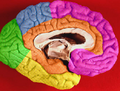 Brain lobes - medial surface with limbic lobe
 -
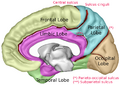 Lobes captions medial view 1
 -
Lobes captions medial view 2
-
Limbic lobe coronal sections
-
Limbic lobe sagittal sections
-
Limbic lobe transversal sections


Medical Disclaimer: WikiMD is for informational purposes only and is not a substitute for professional medical advice. Content may be inaccurate or outdated and should not be used for diagnosis or treatment. Always consult your healthcare provider for medical decisions. Verify information with trusted sources such as CDC.gov and NIH.gov. By using this site, you agree that WikiMD is not liable for any outcomes related to its content. See full disclaimer.
Credits:Most images are courtesy of Wikimedia commons, and templates, categories Wikipedia, licensed under CC BY SA or similar.
Translate page: - East Asian
中文,
日本,
한국어,
South Asian
हिन्दी,
தமிழ்,
తెలుగు,
Urdu,
ಕನ್ನಡ,
Southeast Asian
Indonesian,
Vietnamese,
Thai,
မြန်မာဘာသာ,
বাংলা
European
español,
Deutsch,
français,
Greek,
português do Brasil,
polski,
română,
русский,
Nederlands,
norsk,
svenska,
suomi,
Italian
Middle Eastern & African
عربى,
Turkish,
Persian,
Hebrew,
Afrikaans,
isiZulu,
Kiswahili,
Other
Bulgarian,
Hungarian,
Czech,
Swedish,
മലയാളം,
मराठी,
ਪੰਜਾਬੀ,
ગુજરાતી,
Portuguese,
Ukrainian


