Lifebuoy (soap)
Lifebuoy is a brand of soap that was created by the Lever Brothers in England in 1895. It was one of the first soaps to use carbolic acid, which gave it a red color and strong, medicinal scent. Lifebuoy is currently owned by Unilever.
History[edit]
Lifebuoy was originally, and for much of its history, a carbolic soap containing phenol (carbolic acid, a compound extracted from coal tar). The original Lifebuoy was a hard, mottled, red and white soap with a distinct medicinal carbolic smell. Lifebuoy's distinctive phenol smell was noted in a 1922 New Yorker article that reported "the smell of Lifebuoy soap clinging to the skin is often a source of embarrassment to its users".
Composition[edit]
The primary ingredient of Lifebuoy is sodium palmate, the sodium salt of palmitic acid. It also contains glycerin, water, sodium chloride (salt), tetrasodium EDTA, tetrasodium etidronate, BHT, and fragrance. The red color is achieved with Red 17.
Uses[edit]
Lifebuoy is a popular choice for hygiene purposes in many parts of the world. It is often used in areas where cleanliness is a priority, such as hospitals and kitchens. The soap's antibacterial properties make it a good choice for preventing the spread of diseases.
Marketing[edit]
Lifebuoy has been marketed for many years with the slogan "Lifebuoy — the soap that saves lives". This is a reference to the soap's original purpose as a disinfectant to combat the cholera epidemic in 19th century England.
See also[edit]
|
|
This article is a stub You can help WikiMD by registering and expanding it with useful details, internal links, formatting, and categories. Editing is available only to registered and verified users. WikiMD is a comprehensive, free health and wellness encyclopedia. |

This <a href="Unilever" title="Unilever">Unilever</a>-related article is a <a href="stub" title="stub">stub</a>. You can help <a href="WikiMD" title="WikiMD">WikiMD</a> by expanding it.
 | This medical article is a stub. You can help WikiMD by expanding the page. |
-
 Lifebuoy (soap)
 -
 Magazine insert advertising Lifebuoy soap
 -
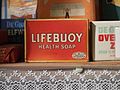 Lifebuoy Health soap
 -
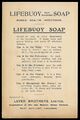 Advert for Lifebuoy Soap
 -
 Lifebuoy (soap)


_(18011899630).jpg)

Medical Disclaimer: WikiMD is for informational purposes only and is not a substitute for professional medical advice. Content may be inaccurate or outdated and should not be used for diagnosis or treatment. Always consult your healthcare provider for medical decisions. Verify information with trusted sources such as CDC.gov and NIH.gov. By using this site, you agree that WikiMD is not liable for any outcomes related to its content. See full disclaimer.
Credits:Most images are courtesy of Wikimedia commons, and templates, categories Wikipedia, licensed under CC BY SA or similar.
Translate page: - East Asian
中文,
日本,
한국어,
South Asian
हिन्दी,
தமிழ்,
తెలుగు,
Urdu,
ಕನ್ನಡ,
Southeast Asian
Indonesian,
Vietnamese,
Thai,
မြန်မာဘာသာ,
বাংলা
European
español,
Deutsch,
français,
Greek,
português do Brasil,
polski,
română,
русский,
Nederlands,
norsk,
svenska,
suomi,
Italian
Middle Eastern & African
عربى,
Turkish,
Persian,
Hebrew,
Afrikaans,
isiZulu,
Kiswahili,
Other
Bulgarian,
Hungarian,
Czech,
Swedish,
മലയാളം,
मराठी,
ਪੰਜਾਬੀ,
ગુજરાતી,
Portuguese,
Ukrainian

