Labioscrotal swelling
Labioscrotal swelling is a significant stage in the sexual differentiation process during the embryonic development of mammals, including humans. It is the precursor to the formation of the labia majora in females and the scrotum in males.
Development[edit]
The labioscrotal swellings appear in the fifth week of gestation and are initially identical in both sexes. They are located on either side of the urogenital folds. The swellings are formed by rapid cell proliferation and fluid accumulation within the mesenchyme, a type of connective tissue.
In males, under the influence of testosterone, the labioscrotal swellings enlarge, move towards each other and fuse in the midline to form the scrotum. This process is usually completed by the ninth week of gestation.
In females, in the absence of testosterone, the labioscrotal swellings do not fuse but grow to form the labia majora. The process is completed by the twelfth week of gestation.
Clinical significance[edit]
Abnormalities in the development of the labioscrotal swellings can lead to a variety of congenital disorders, including hypospadias, epispadias, and ambiguous genitalia. These conditions can have significant psychological and physical impacts and often require surgical intervention.
See also[edit]
References[edit]
 | This Embryology article is a stub. You can help WikiMD by expanding the page. |
Labioscrotal swelling gallery[edit]
-
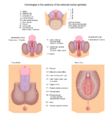 Human genitalia - development 1


Medical Disclaimer: WikiMD is for informational purposes only and is not a substitute for professional medical advice. Content may be inaccurate or outdated and should not be used for diagnosis or treatment. Always consult your healthcare provider for medical decisions. Verify information with trusted sources such as CDC.gov and NIH.gov. By using this site, you agree that WikiMD is not liable for any outcomes related to its content. See full disclaimer.
Credits:Most images are courtesy of Wikimedia commons, and templates, categories Wikipedia, licensed under CC BY SA or similar.
Translate page: - East Asian
中文,
日本,
한국어,
South Asian
हिन्दी,
தமிழ்,
తెలుగు,
Urdu,
ಕನ್ನಡ,
Southeast Asian
Indonesian,
Vietnamese,
Thai,
မြန်မာဘာသာ,
বাংলা
European
español,
Deutsch,
français,
Greek,
português do Brasil,
polski,
română,
русский,
Nederlands,
norsk,
svenska,
suomi,
Italian
Middle Eastern & African
عربى,
Turkish,
Persian,
Hebrew,
Afrikaans,
isiZulu,
Kiswahili,
Other
Bulgarian,
Hungarian,
Czech,
Swedish,
മലയാളം,
मराठी,
ਪੰਜਾਬੀ,
ગુજરાતી,
Portuguese,
Ukrainian

