Jollof rice
Jollof rice is a popular dish in many parts of West Africa. It is often made with rice, tomatoes and tomato paste, onion, salt, and red pepper. Other ingredients can be added such as vegetables, meats, or fish. The dish is a staple in many West African countries, including Nigeria, Ghana, Senegal, and The Gambia.
History[edit]
The origins of Jollof rice can be traced back to the Senegambia region that was ruled by the Jolof Empire. This dish is a testament to the cultural and culinary influence of the Jolof Empire in West Africa.
Preparation[edit]
The preparation of Jollof rice begins with frying onions in oil, then adding tomato paste and fresh tomatoes along with the spices. Once this mixture is well cooked, rice is added and cooked until it absorbs all the flavors. The dish is often garnished with vegetables, meats, or fish.
Variations[edit]
There are many variations of Jollof rice across different West African countries. The Nigerian Jollof rice is typically spicy and includes ingredients like pepper, curry powder, and thyme. The Ghanaian Jollof rice, on the other hand, often includes basmati rice and is usually less spicy. The Senegalese version, known as Ceebu Jën, includes fish, shellfish, and a variety of vegetables.
Cultural significance[edit]
Jollof rice is more than just a meal in West Africa. It is a dish that is often served at parties, weddings, and other social gatherings. It is also a source of national pride and friendly rivalry, particularly between Nigerians and Ghanaians over whose version of the dish is superior.
See also[edit]


-
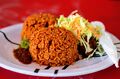 Jollof Rice with Stew
 -
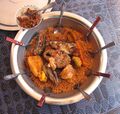 Thiéboudiène Boukhonk with Tamarind


Medical Disclaimer: WikiMD is for informational purposes only and is not a substitute for professional medical advice. Content may be inaccurate or outdated and should not be used for diagnosis or treatment. Always consult your healthcare provider for medical decisions. Verify information with trusted sources such as CDC.gov and NIH.gov. By using this site, you agree that WikiMD is not liable for any outcomes related to its content. See full disclaimer.
Credits:Most images are courtesy of Wikimedia commons, and templates, categories Wikipedia, licensed under CC BY SA or similar.
Translate page: - East Asian
中文,
日本,
한국어,
South Asian
हिन्दी,
தமிழ்,
తెలుగు,
Urdu,
ಕನ್ನಡ,
Southeast Asian
Indonesian,
Vietnamese,
Thai,
မြန်မာဘာသာ,
বাংলা
European
español,
Deutsch,
français,
Greek,
português do Brasil,
polski,
română,
русский,
Nederlands,
norsk,
svenska,
suomi,
Italian
Middle Eastern & African
عربى,
Turkish,
Persian,
Hebrew,
Afrikaans,
isiZulu,
Kiswahili,
Other
Bulgarian,
Hungarian,
Czech,
Swedish,
മലയാളം,
मराठी,
ਪੰਜਾਬੀ,
ગુજરાતી,
Portuguese,
Ukrainian

