Isatin
Isatin is an organic compound with the molecular formula C8H5NO2. It is an indole derivative, specifically an oxindole, and is a yellowish to orange solid. Isatin is a versatile molecule that has been used as a starting material in the synthesis of a wide variety of chemical compounds, including pharmaceuticals, dyes, and agrochemicals.
History[edit]
Isatin was first discovered in 1841 by the German chemist Friedrich Wöhler and the Swiss chemist Justus von Liebig. They isolated it from indigo dye, a natural dye that has been used for thousands of years. The name "isatin" comes from the Greek word "isatis", which means "indigo".
Properties and structure[edit]
Isatin is a crystalline solid that is yellowish to orange in color. It has a melting point of 200-202 °C and a boiling point of 389.8 °C at 760 mmHg. It is soluble in ethanol, acetone, and hot water, but insoluble in cold water and petroleum ether.
The structure of isatin is based on the indole skeleton, which consists of a benzene ring fused to a pyrrole ring. In isatin, the pyrrole ring is further modified to an oxindole, meaning it contains an oxygen atom. The molecule also contains a carbonyl group and a nitrogen atom, which contribute to its reactivity.
Synthesis[edit]
Isatin can be synthesized from indigo dye by oxidation with nitric acid. This is the method that was originally used by Wöhler and Liebig. However, there are now many other methods available for the synthesis of isatin, including the Sandmeyer isatin synthesis, the Gassman isatin synthesis, and the Japp-Klingemann reaction.
Applications[edit]
Isatin is a versatile starting material in organic synthesis. It has been used to synthesize a wide variety of chemical compounds, including pharmaceuticals, dyes, and agrochemicals. Some of the pharmaceuticals that have been synthesized from isatin include oxindole, isatinic acid, and isatinic anhydride.
See also[edit]
References[edit]

This WikiMD article can only be edited by registered and verified editors. You can log in or register.
-
Sendmeyer synthesis of Isatin
-
Stolle synthesis of Isatin
-
Oxidation synthesis of Isatin
-
Isatin N-alkylation, acylation
-
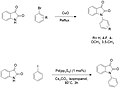 Isatin Arylation
 -
Isatin ring expansion
-
Isatin ring expansion
-
Isatin nucleophilic addition
-
Isatin oxidation
-
 Isatin dimerization


Medical Disclaimer: WikiMD is for informational purposes only and is not a substitute for professional medical advice. Content may be inaccurate or outdated and should not be used for diagnosis or treatment. Always consult your healthcare provider for medical decisions. Verify information with trusted sources such as CDC.gov and NIH.gov. By using this site, you agree that WikiMD is not liable for any outcomes related to its content. See full disclaimer.
Credits:Most images are courtesy of Wikimedia commons, and templates, categories Wikipedia, licensed under CC BY SA or similar.
Translate page: - East Asian
中文,
日本,
한국어,
South Asian
हिन्दी,
தமிழ்,
తెలుగు,
Urdu,
ಕನ್ನಡ,
Southeast Asian
Indonesian,
Vietnamese,
Thai,
မြန်မာဘာသာ,
বাংলা
European
español,
Deutsch,
français,
Greek,
português do Brasil,
polski,
română,
русский,
Nederlands,
norsk,
svenska,
suomi,
Italian
Middle Eastern & African
عربى,
Turkish,
Persian,
Hebrew,
Afrikaans,
isiZulu,
Kiswahili,
Other
Bulgarian,
Hungarian,
Czech,
Swedish,
മലയാളം,
मराठी,
ਪੰਜਾਬੀ,
ગુજરાતી,
Portuguese,
Ukrainian


