Signal transduction
Signal transduction is the process by which a chemical or physical signal is transmitted through a cell as a series of molecular events, most commonly protein phosphorylation catalyzed by protein kinases, which ultimately results in a cellular response. Proteins responsible for detecting stimuli are generally termed receptors, although in some cases the term sensor is used. The changes elicited by ligand binding (or signal sensing) in a receptor give rise to a biochemical cascade, which is a chain of biochemical events known as a signaling pathway.
Overview[edit]
Signal transduction involves the binding of extracellular signaling molecules and ligands to cell-surface receptors that trigger events inside the cell. The combination of messenger with receptor causes a change in the conformation of the receptor, known as receptor activation. This activation is always the initial step (the cause) leading to the cell's ultimate responses (effect) to the messenger. Despite the myriad of these ultimate responses, they are all directly due to changes in particular cell proteins. Intracellular signaling cascades can be started through cell-substratum interactions; examples are the integrin that binds ligands in the extracellular matrix and steroids.
Types of receptors[edit]
Receptors can be roughly divided into two major classes: intracellular receptors and extracellular receptors.
Intracellular receptors[edit]
Intracellular receptors are those found inside the cell, and include nuclear receptors and certain hormone receptors. They are activated by hydrophobic ligands, such as steroid hormones, thyroid hormones, vitamin D3, and retinoids, that pass through the plasma membrane. Upon binding, these receptors often form dimers in the cytosol and then translocate into the nucleus, where they regulate the expression of genes.
Extracellular receptors[edit]
Extracellular receptors are integral transmembrane proteins and make up most receptors. They are activated by hydrophilic ligands that cannot cross the plasma membrane. The ligands bind to the extracellular domain of the receptor. A conformational change in the protein causes intracellular domain to initiate intracellular signaling events.
See also[edit]
- Cell signaling
- Endocrine system
- Neurotransmission
- Paracrine signalling
- Autocrine signalling
- Juxtacrine signalling
- Intercrine
References[edit]

This WikiMD article can only be edited by registered and verified editors. You can log in or register.
Signal_transduction[edit]
-
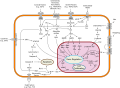 Signal transduction pathways
 -
 Signal transduction
 -
 Integrin signal transduction overview
 -
 How to read signal transduction diagrams
 -
 Elements of signal transduction cascade networking
 -
 Signal transduction publications graph


Advertise on WikiMD — 81,000+ full articles, ~900,000 total pages, ~250 million page views. Global reach, limited time promotional rates from $1/page/day. Learn more · View stats

Medical Disclaimer: WikiMD is for informational purposes only and is not a substitute for professional medical advice. Content may be inaccurate or outdated and should not be used for diagnosis or treatment. Always consult your healthcare provider for medical decisions. Verify information with trusted sources such as CDC.gov and NIH.gov. By using this site, you agree that WikiMD is not liable for any outcomes related to its content. See full disclaimer.
Credits:Most images are courtesy of Wikimedia commons, and templates, categories Wikipedia, licensed under CC BY SA or similar.
Translate page: - East Asian
中文,
日本,
한국어,
South Asian
हिन्दी,
தமிழ்,
తెలుగు,
Urdu,
ಕನ್ನಡ,
Southeast Asian
Indonesian,
Vietnamese,
Thai,
မြန်မာဘာသာ,
বাংলা
European
español,
Deutsch,
français,
Greek,
português do Brasil,
polski,
română,
русский,
Nederlands,
norsk,
svenska,
suomi,
Italian
Middle Eastern & African
عربى,
Turkish,
Persian,
Hebrew,
Afrikaans,
isiZulu,
Kiswahili,
Other
Bulgarian,
Hungarian,
Czech,
Swedish,
മലയാളം,
मराठी,
ਪੰਜਾਬੀ,
ગુજરાતી,
Portuguese,
Ukrainian

