Intervillous space
Intervillous space is a term used in anatomy and embryology to describe the space within the placenta where maternal blood is found. This space is crucial for the exchange of nutrients and waste products between the mother and the fetus.
Etymology[edit]
The term "intervillous" is derived from the Latin words "inter", meaning between, and "villus", meaning shaggy hair. This refers to the hair-like projections of the placenta that extend into the intervillous space.
Anatomy[edit]
The intervillous space is located within the placenta, specifically between the chorionic villi. The chorionic villi are projections of the placenta that extend into the intervillous space. These villi are covered in trophoblast cells, which facilitate the exchange of nutrients and waste products between the mother and the fetus.
The intervillous space is filled with maternal blood, which is delivered to the space by the spiral arteries. The blood in the intervillous space is in direct contact with the trophoblast cells of the chorionic villi, allowing for the exchange of nutrients and waste products.
Function[edit]
The primary function of the intervillous space is to facilitate the exchange of nutrients and waste products between the mother and the fetus. This is accomplished through the diffusion of substances across the trophoblast cells of the chorionic villi.
In addition to nutrient and waste exchange, the intervillous space also plays a role in the immune tolerance of the fetus. The maternal blood in the intervillous space contains immune cells that help to protect the fetus from infection.
Related Terms[edit]
- Placenta: The organ that connects the developing fetus to the uterine wall to allow nutrient uptake, waste elimination, and gas exchange via the mother's blood supply.
- Chorionic villi: Tiny, finger-like projections that come from the placenta and extend into the intervillous space.
- Trophoblast: Cells forming the outer layer of a blastocyst, which provide nutrients to the embryo and develop into a large part of the placenta.
- Spiral arteries: Arteries that supply blood to the intervillous space of the placenta.

This WikiMD article can only be edited by registered and verified editors. You can log in or register.
-
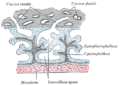 Diagram of the placenta showing the intervillous space
 -
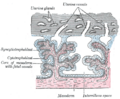 Cross-section of the placenta highlighting the intervillous space
 -
Intervillous space


Medical Disclaimer: WikiMD is for informational purposes only and is not a substitute for professional medical advice. Content may be inaccurate or outdated and should not be used for diagnosis or treatment. Always consult your healthcare provider for medical decisions. Verify information with trusted sources such as CDC.gov and NIH.gov. By using this site, you agree that WikiMD is not liable for any outcomes related to its content. See full disclaimer.
Credits:Most images are courtesy of Wikimedia commons, and templates, categories Wikipedia, licensed under CC BY SA or similar.
Translate page: - East Asian
中文,
日本,
한국어,
South Asian
हिन्दी,
தமிழ்,
తెలుగు,
Urdu,
ಕನ್ನಡ,
Southeast Asian
Indonesian,
Vietnamese,
Thai,
မြန်မာဘာသာ,
বাংলা
European
español,
Deutsch,
français,
Greek,
português do Brasil,
polski,
română,
русский,
Nederlands,
norsk,
svenska,
suomi,
Italian
Middle Eastern & African
عربى,
Turkish,
Persian,
Hebrew,
Afrikaans,
isiZulu,
Kiswahili,
Other
Bulgarian,
Hungarian,
Czech,
Swedish,
മലയാളം,
मराठी,
ਪੰਜਾਬੀ,
ગુજરાતી,
Portuguese,
Ukrainian


