Inflammasome
Inflammasome is a multiprotein oligomer responsible for the activation of inflammatory responses. The inflammasome promotes the maturation and secretion of pro-inflammatory cytokines IL-1β and IL-18.
Structure[edit]
The inflammasome complex is composed of a sensor molecule, an adaptor protein ASC, and an effector protein caspase-1. The sensor molecule, which can be a member of the NLR or ALR family, detects pathogenic microorganisms and sterile stressors.
Function[edit]
Inflammasomes respond to a wide range of stimuli, including microbial pathogens, molecules derived from host proteins, and foreign substances. Upon activation, the inflammasome forms a platform for the activation of caspase-1, which subsequently cleaves the pro-inflammatory cytokines IL-1β and IL-18 into their active forms.
Role in Disease[edit]
Inflammasomes play a crucial role in the innate immune response, and their dysregulation can lead to a variety of diseases, including autoinflammatory diseases, autoimmune diseases, metabolic disorders, and cancer.
See Also[edit]
References[edit]

This WikiMD article can only be edited by registered and verified editors. You can log in or register.
-
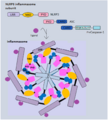 Inflammasome final 1

Advertise on WikiMD — 81,000+ full articles, ~900,000 total pages, ~250 million page views. Global reach, limited time promotional rates from $1/page/day. Learn more · View stats


Translate page: - East Asian
中文,
日本,
한국어,
South Asian
हिन्दी,
தமிழ்,
తెలుగు,
Urdu,
ಕನ್ನಡ,
Southeast Asian
Indonesian,
Vietnamese,
Thai,
မြန်မာဘာသာ,
বাংলা
European
español,
Deutsch,
français,
Greek,
português do Brasil,
polski,
română,
русский,
Nederlands,
norsk,
svenska,
suomi,
Italian
Middle Eastern & African
عربى,
Turkish,
Persian,
Hebrew,
Afrikaans,
isiZulu,
Kiswahili,
Other
Bulgarian,
Hungarian,
Czech,
Swedish,
മലയാളം,
मराठी,
ਪੰਜਾਬੀ,
ગુજરાતી,
Portuguese,
Ukrainian
About WikiMD • Contact • Disclaimer • Privacy • Copyright • Site statistics
Some content and images may originate from Wikimedia Commons or Wikipedia and remain subject to their stated licenses. Unless otherwise noted, eligible WikiMD content is available under CC BY-SA 4.0.
WikiMD Wellnesspedia — Free health & wellness information for patients, students, and health professionals.

