Incubation period
The time between exposure to a pathogen and the appearance of symptoms
| Incubation period | |
|---|---|
| Concept of incubation period.svg | |
| Synonyms | N/A |
| Pronounce | N/A |
| Specialty | N/A |
| Symptoms | N/A |
| Complications | N/A |
| Onset | N/A |
| Duration | N/A |
| Types | N/A |
| Causes | N/A |
| Risks | N/A |
| Diagnosis | N/A |
| Differential diagnosis | N/A |
| Prevention | N/A |
| Treatment | N/A |
| Medication | N/A |
| Prognosis | N/A |
| Frequency | N/A |
| Deaths | N/A |
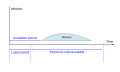
The incubation period is the time interval between exposure to a pathogenic organism, a chemical, or radiation, and the appearance of the first symptoms or signs of disease. It is a critical concept in epidemiology and infectious disease management, as it helps in understanding the dynamics of disease spread and in implementing control measures.
Overview[edit]
The incubation period can vary widely depending on the type of pathogen and the host's immune response. For example, the incubation period for the common cold is typically 1 to 3 days, while for HIV/AIDS, it can be several years. Understanding the incubation period is essential for quarantine measures, contact tracing, and disease surveillance.
Factors Influencing Incubation Period[edit]
Several factors can influence the incubation period, including:
- Pathogen characteristics: Different pathogens have different replication rates and mechanisms of action, which can affect the incubation period.
- Dose of exposure: A higher dose of the pathogen may lead to a shorter incubation period.
- Route of entry: The way a pathogen enters the body (e.g., inhalation, ingestion, or skin contact) can influence the incubation period.
- Host factors: The immune status, age, and genetic factors of the host can affect how quickly symptoms appear.
Examples of Incubation Periods[edit]
- Influenza: 1 to 4 days
- COVID-19: 2 to 14 days, with a median of 5 to 6 days
- Measles: 10 to 12 days
- Rabies: 1 to 3 months, but can vary from less than a week to more than a year
Importance in Public Health[edit]
The incubation period is crucial for determining the period of infectiousness and for setting guidelines for isolation and quarantine. It also helps in predicting the epidemic curve and in planning vaccination campaigns.
Also see[edit]
| Infectious diseases | ||||||||||
|---|---|---|---|---|---|---|---|---|---|---|
This infectious diseases related article is a stub.
|
-
 Incubation period


Medical Disclaimer: WikiMD is for informational purposes only and is not a substitute for professional medical advice. Content may be inaccurate or outdated and should not be used for diagnosis or treatment. Always consult your healthcare provider for medical decisions. Verify information with trusted sources such as CDC.gov and NIH.gov. By using this site, you agree that WikiMD is not liable for any outcomes related to its content. See full disclaimer.
Credits:Most images are courtesy of Wikimedia commons, and templates, categories Wikipedia, licensed under CC BY SA or similar.
Translate page: - East Asian
中文,
日本,
한국어,
South Asian
हिन्दी,
தமிழ்,
తెలుగు,
Urdu,
ಕನ್ನಡ,
Southeast Asian
Indonesian,
Vietnamese,
Thai,
မြန်မာဘာသာ,
বাংলা
European
español,
Deutsch,
français,
Greek,
português do Brasil,
polski,
română,
русский,
Nederlands,
norsk,
svenska,
suomi,
Italian
Middle Eastern & African
عربى,
Turkish,
Persian,
Hebrew,
Afrikaans,
isiZulu,
Kiswahili,
Other
Bulgarian,
Hungarian,
Czech,
Swedish,
മലയാളം,
मराठी,
ਪੰਜਾਬੀ,
ગુજરાતી,
Portuguese,
Ukrainian

