Immunohistochemistry
Immunohistochemistry (IHC) is a method in pathology that uses the principle of antibodies binding specifically to antigens in biological tissues. This technique is widely used in the diagnosis of cancer, as it can demonstrate the presence and localization of specific proteins in tissues.
History[edit]
Immunohistochemistry was first described by Albert H. Coons in 1941 when he used a fluorescent tag to directly label antibodies to visualize pneumococcal antigens in infected tissues.
Methodology[edit]
The process of immunohistochemistry involves several steps. First, the tissue is fixed and embedded in paraffin to preserve the structure and proteins. The tissue is then sectioned and placed on a slide. The slide is then treated with antibodies that bind to the protein of interest. These antibodies can be visualized by a variety of methods, including fluorescence or enzymatic methods.
Applications[edit]
Immunohistochemistry is used in a wide range of applications, including:
- Cancer diagnosis: IHC can be used to identify the type and origin of cancer cells.
- Infectious disease diagnosis: IHC can be used to identify specific pathogens in tissue samples.
- Research: IHC is used in research to understand the distribution and localization of biomarkers and protein expression in different tissues.
Limitations[edit]
While immunohistochemistry is a powerful tool, it does have some limitations. These include potential issues with specificity and sensitivity, as well as the need for careful control experiments to ensure accurate interpretation of results.
See Also[edit]
References[edit]
<references />
 | |
|---|---|
 |
 |
-
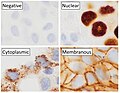 Main staining patterns on immunohistochemistry
 -
 HSP IF IgA
 -
 Immunohistochemistry for p16 in uterine papillary serous adenocarcinoma showing both nuclear and cytoplasmic staining
 -
 Chromogenic immunohistochemistry
 -
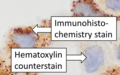 Immunohistochemistry stain versus counterstain
 -
 Positive and negative controls in immunohistochemistry
 -
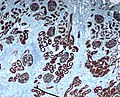 Kidney CD10 IHC
 -
 PIN-4 staining of benign prostate gland and adenocarcinoma


Ad. Transform your health with W8MD Weight Loss, Sleep & MedSpa

Tired of being overweight?
Special offer:
Budget GLP-1 weight loss medications
- Semaglutide starting from $29.99/week and up with insurance for visit of $59.99 and up per week self pay.
- Tirzepatide starting from $45.00/week and up (dose dependent) or $69.99/week and up self pay
✔ Same-week appointments, evenings & weekends
Learn more:
- GLP-1 weight loss clinic NYC
- W8MD's NYC medical weight loss
- W8MD Philadelphia GLP-1 shots
- Philadelphia GLP-1 injections
- Affordable GLP-1 shots NYC
|
WikiMD Medical Encyclopedia |
Medical Disclaimer: WikiMD is for informational purposes only and is not a substitute for professional medical advice. Content may be inaccurate or outdated and should not be used for diagnosis or treatment. Always consult your healthcare provider for medical decisions. Verify information with trusted sources such as CDC.gov and NIH.gov. By using this site, you agree that WikiMD is not liable for any outcomes related to its content. See full disclaimer.
Credits:Most images are courtesy of Wikimedia commons, and templates, categories Wikipedia, licensed under CC BY SA or similar.
Translate this page: - East Asian
中文,
日本,
한국어,
South Asian
हिन्दी,
தமிழ்,
తెలుగు,
Urdu,
ಕನ್ನಡ,
Southeast Asian
Indonesian,
Vietnamese,
Thai,
မြန်မာဘာသာ,
বাংলা
European
español,
Deutsch,
français,
Greek,
português do Brasil,
polski,
română,
русский,
Nederlands,
norsk,
svenska,
suomi,
Italian
Middle Eastern & African
عربى,
Turkish,
Persian,
Hebrew,
Afrikaans,
isiZulu,
Kiswahili,
Other
Bulgarian,
Hungarian,
Czech,
Swedish,
മലയാളം,
मराठी,
ਪੰਜਾਬੀ,
ગુજરાતી,
Portuguese,
Ukrainian
