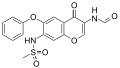
Iguratimod
Overview of the drug Iguratimod
| Iguratimod | |
|---|---|
|
|

Iguratimod is a disease-modifying antirheumatic drug (DMARD) used primarily in the treatment of rheumatoid arthritis. It is known for its anti-inflammatory and immunomodulatory effects. Iguratimod is particularly noted for its ability to inhibit the production of inflammatory cytokines and the activation of NF-_B.
Mechanism of Action[edit]
Iguratimod works by modulating the immune response. It inhibits the production of pro-inflammatory cytokines such as TNF-_, IL-1, and IL-6. Additionally, it suppresses the activation of NF-_B, a transcription factor that plays a key role in the inflammatory response. This dual action helps reduce inflammation and slow the progression of joint damage in rheumatoid arthritis.
Pharmacokinetics[edit]
Iguratimod is administered orally and is absorbed through the gastrointestinal tract. It undergoes hepatic metabolism and is excreted primarily in the urine. The drug has a half-life that allows for once-daily dosing, which can improve patient compliance.
Clinical Use[edit]
Iguratimod is used in the management of rheumatoid arthritis, particularly in patients who have not responded adequately to other DMARDs. It can be used as monotherapy or in combination with other antirheumatic drugs such as methotrexate.
Side Effects[edit]
Common side effects of iguratimod include gastrointestinal disturbances, such as nausea and diarrhea, as well as liver enzyme elevations. Patients on iguratimod require regular monitoring of liver function tests. Less commonly, it may cause leukopenia or thrombocytopenia.
Contraindications[edit]
Iguratimod is contraindicated in patients with known hypersensitivity to the drug. It should be used with caution in patients with liver impairment or a history of liver disease.
Related Pages[edit]
- Rheumatoid arthritis
- Disease-modifying antirheumatic drug
- Cytokine
- Nuclear factor kappa-light-chain-enhancer of activated B cells
-
 Iguratimod

Medical Disclaimer: WikiMD is for informational purposes only and is not a substitute for professional medical advice. Content may be inaccurate or outdated and should not be used for diagnosis or treatment. Always consult your healthcare provider for medical decisions. Verify information with trusted sources such as CDC.gov and NIH.gov. By using this site, you agree that WikiMD is not liable for any outcomes related to its content. See full disclaimer.
Credits:Most images are courtesy of Wikimedia commons, and templates, categories Wikipedia, licensed under CC BY SA or similar.
Translate page: - East Asian
中文,
日本,
한국어,
South Asian
हिन्दी,
தமிழ்,
తెలుగు,
Urdu,
ಕನ್ನಡ,
Southeast Asian
Indonesian,
Vietnamese,
Thai,
မြန်မာဘာသာ,
বাংলা
European
español,
Deutsch,
français,
Greek,
português do Brasil,
polski,
română,
русский,
Nederlands,
norsk,
svenska,
suomi,
Italian
Middle Eastern & African
عربى,
Turkish,
Persian,
Hebrew,
Afrikaans,
isiZulu,
Kiswahili,
Other
Bulgarian,
Hungarian,
Czech,
Swedish,
മലയാളം,
मराठी,
ਪੰਜਾਬੀ,
ગુજરાતી,
Portuguese,
Ukrainian

