Fluid dynamics
Fluid dynamics is a sub-discipline of Fluid mechanics that deals with fluid flow—the natural science of fluids (liquids and gases) in motion. It has several sub-disciplines itself, including Aerodynamics (the study of air and other gases in motion) and Hydrodynamics (the study of liquids in motion). Fluid dynamics has a wide range of applications, including calculating forces and moments on aircraft, determining the mass flow rate of petroleum through pipelines, predicting weather patterns, understanding nebulae in interstellar space and modelling fission in nuclear reactors.
Fundamental principles[edit]
Fluid dynamics is governed by two fundamental principles: Conservation of mass and Conservation of energy. The principle of conservation of mass states that the rate of change of mass in an isolated system is zero. The principle of conservation of energy, also known as the first law of thermodynamics, states that energy cannot be created or destroyed, only transferred or changed from one form to another.
Equations of fluid dynamics[edit]
The foundational axioms of fluid dynamics are the Navier-Stokes equations, a set of equations that describe the motion of fluid substances. These equations are based on the principles of conservation of momentum, conservation of mass, and conservation of energy. They can be simplified in a number of ways, all of which make them easier to solve. Some of the simplified forms include the Euler equations, Potential flow equation, and the Boundary layer equation.
Applications of fluid dynamics[edit]
Fluid dynamics is used in a wide variety of applications. Some of the most common include:
- Aerodynamics: The study of how gases interact with moving bodies. This is crucial in many fields, including aviation, automotive design, and meteorology.
- Hydrodynamics: The study of liquids in motion, with applications in areas such as naval architecture and marine engineering.
- Weather forecasting: Fluid dynamics is used to model the Earth's atmosphere and oceans, which are both fluid systems.
- Astrophysics: Many phenomena in the universe, from the formation of stars to the behavior of galaxies, can be understood through the principles of fluid dynamics.
See also[edit]
 | This physics-related article is a stub. You can help WikiMD by expanding the page. |
Fluid_dynamics[edit]
-
 Von Karman vortex street in a wind tunnel
 -
 Teardrop shape illustrating streamlined flow
 -
 Flow visualization around an aircraft wing
 -
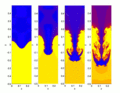 Rayleigh-Taylor instability simulation
 -
 Laminar to turbulent flow transition


Medical Disclaimer: WikiMD is for informational purposes only and is not a substitute for professional medical advice. Content may be inaccurate or outdated and should not be used for diagnosis or treatment. Always consult your healthcare provider for medical decisions. Verify information with trusted sources such as CDC.gov and NIH.gov. By using this site, you agree that WikiMD is not liable for any outcomes related to its content. See full disclaimer.
Credits:Most images are courtesy of Wikimedia commons, and templates, categories Wikipedia, licensed under CC BY SA or similar.
Translate page: - East Asian
中文,
日本,
한국어,
South Asian
हिन्दी,
தமிழ்,
తెలుగు,
Urdu,
ಕನ್ನಡ,
Southeast Asian
Indonesian,
Vietnamese,
Thai,
မြန်မာဘာသာ,
বাংলা
European
español,
Deutsch,
français,
Greek,
português do Brasil,
polski,
română,
русский,
Nederlands,
norsk,
svenska,
suomi,
Italian
Middle Eastern & African
عربى,
Turkish,
Persian,
Hebrew,
Afrikaans,
isiZulu,
Kiswahili,
Other
Bulgarian,
Hungarian,
Czech,
Swedish,
മലയാളം,
मराठी,
ਪੰਜਾਬੀ,
ગુજરાતી,
Portuguese,
Ukrainian

