Conservation of energy
Conservation of Energy is a fundamental concept in physics that states that the total amount of energy in an isolated system remains constant over time. This principle, also known as the First Law of Thermodynamics, implies that energy can neither be created nor destroyed, but can only be transformed from one form to another.
Overview[edit]
The principle of Conservation of Energy is based on the observation that the total energy of an isolated system is always conserved, regardless of the specific nature of the system or the processes it undergoes. This principle is a fundamental law of nature and is applicable to all physical and chemical processes.
History[edit]
The concept of energy conservation has been recognized since ancient times, but it was not until the 19th century that it was formally articulated by physicists such as James Prescott Joule and Julius Robert von Mayer. These scientists conducted experiments that demonstrated the convertibility of different forms of energy and established the principle of energy conservation as a fundamental law of physics.
Forms of Energy[edit]
Energy can exist in various forms, including kinetic energy, potential energy, thermal energy, chemical energy, electrical energy, and nuclear energy. The principle of energy conservation implies that the total amount of energy in an isolated system can change from one form to another, but the total energy remains constant.
Applications[edit]
The principle of energy conservation has numerous applications in various fields of science and engineering. For example, it is used in the analysis of electric circuits, in the design of heat engines, and in the study of chemical reactions. It is also used in the field of environmental science to analyze the flow of energy in ecosystems.
See Also[edit]
References[edit]

This WikiMD article can only be edited by registered and verified editors. You can log in or register.
-
Gottfried Wilhelm Leibniz
-
Daniel Bernoulli
-
 Émilie du Châtelet
 -
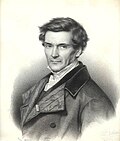 Gaspard-Gustave de Coriolis
 -
James Prescott Joule
-
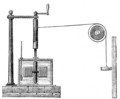 Joule's Apparatus
 -
 Emmy Noether


.png)


Medical Disclaimer: WikiMD is for informational purposes only and is not a substitute for professional medical advice. Content may be inaccurate or outdated and should not be used for diagnosis or treatment. Always consult your healthcare provider for medical decisions. Verify information with trusted sources such as CDC.gov and NIH.gov. By using this site, you agree that WikiMD is not liable for any outcomes related to its content. See full disclaimer.
Credits:Most images are courtesy of Wikimedia commons, and templates, categories Wikipedia, licensed under CC BY SA or similar.
Translate page: - East Asian
中文,
日本,
한국어,
South Asian
हिन्दी,
தமிழ்,
తెలుగు,
Urdu,
ಕನ್ನಡ,
Southeast Asian
Indonesian,
Vietnamese,
Thai,
မြန်မာဘာသာ,
বাংলা
European
español,
Deutsch,
français,
Greek,
português do Brasil,
polski,
română,
русский,
Nederlands,
norsk,
svenska,
suomi,
Italian
Middle Eastern & African
عربى,
Turkish,
Persian,
Hebrew,
Afrikaans,
isiZulu,
Kiswahili,
Other
Bulgarian,
Hungarian,
Czech,
Swedish,
മലയാളം,
मराठी,
ਪੰਜਾਬੀ,
ગુજરાતી,
Portuguese,
Ukrainian


