Humeroulnar joint
Humeroulnar joint is a type of synovial joint that connects the humerus and the ulna, two of the main bones in the human arm. It is one of the two joints that form the elbow, the other being the humeroradial joint. The humeroulnar joint is responsible for the flexion and extension of the arm, and is a key component in many common movements, such as lifting and throwing.
Etymology[edit]
The term "humeroulnar" is derived from the names of the two bones that form the joint: the humerus, which is the long bone in the upper arm, and the ulna, which is one of the two long bones in the forearm. The word "humerus" comes from the Latin word for "shoulder", while "ulna" is derived from the Latin word for "elbow".
Anatomy[edit]
The humeroulnar joint is a hinge joint, a type of synovial joint that allows for movement in one plane. The joint is formed by the articulation of the trochlea of the humerus with the trochlear notch of the ulna. The joint is stabilized by a number of ligaments, including the ulnar collateral ligament and the radial collateral ligament.
Function[edit]
The primary function of the humeroulnar joint is to allow for flexion and extension of the arm. This is achieved through the movement of the trochlea of the humerus within the trochlear notch of the ulna. The joint also contributes to the stability of the elbow, and helps to prevent dislocation.
Clinical significance[edit]
Injuries to the humeroulnar joint can result in a range of conditions, including elbow dislocation, elbow fracture, and elbow arthritis. Treatment for these conditions can vary, but may include physical therapy, medication, or surgery.
See also[edit]

This WikiMD article can only be edited by registered and verified editors. You can log in or register.
-
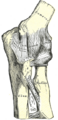 Gray's Anatomy illustration of the humeroulnar joint

Advertise on WikiMD — 81,000+ full articles, ~900,000 total pages, ~250 million page views. Global reach, limited time promotional rates from $1/page/day. Learn more · View stats


Translate page: - East Asian
中文,
日本,
한국어,
South Asian
हिन्दी,
தமிழ்,
తెలుగు,
Urdu,
ಕನ್ನಡ,
Southeast Asian
Indonesian,
Vietnamese,
Thai,
မြန်မာဘာသာ,
বাংলা
European
español,
Deutsch,
français,
Greek,
português do Brasil,
polski,
română,
русский,
Nederlands,
norsk,
svenska,
suomi,
Italian
Middle Eastern & African
عربى,
Turkish,
Persian,
Hebrew,
Afrikaans,
isiZulu,
Kiswahili,
Other
Bulgarian,
Hungarian,
Czech,
Swedish,
മലയാളം,
मराठी,
ਪੰਜਾਬੀ,
ગુજરાતી,
Portuguese,
Ukrainian
About WikiMD • Contact • Disclaimer • Privacy • Copyright • Site statistics
Some content and images may originate from Wikimedia Commons or Wikipedia and remain subject to their stated licenses. Unless otherwise noted, eligible WikiMD content is available under CC BY-SA 4.0.
WikiMD Wellnesspedia — Free health & wellness information for patients, students, and health professionals.

