Hofmann rearrangement
Hofmann Rearrangement (also known as the Hofmann degradation) is an organic reaction that involves the conversion of a primary amide into a primary amine with one fewer carbon atom. This reaction is named after its discoverer, August Wilhelm von Hofmann, who first reported it in 1881. The Hofmann rearrangement is a valuable reaction in organic chemistry for the degradation of amides to amines, which are important functional groups in both synthetic and medicinal chemistry.
Mechanism[edit]
The mechanism of the Hofmann rearrangement involves several key steps. Initially, the primary amide reacts with a halogenating agent, such as bromine in an aqueous solution of sodium hydroxide (NaOH), to form an N-haloamide. This intermediate then undergoes a rearrangement, where the R group (alkyl or aryl group attached to the nitrogen atom) migrates from the nitrogen to the carbonyl carbon atom, leading to the formation of an isocyanate intermediate. The isocyanate reacts with water in the final step to produce a primary amine and carbon dioxide (CO2).
Reagents and Conditions[edit]
The typical reagents for the Hofmann rearrangement include a primary amide, a halogen (usually bromine or chlorine), and a strong base (commonly sodium hydroxide). The reaction is usually carried out in an aqueous solution at temperatures ranging from 0°C to room temperature.
Applications[edit]
The Hofmann rearrangement has been widely used in organic synthesis for the preparation of primary amines, which are valuable intermediates in the synthesis of pharmaceuticals, agrochemicals, and dyes. It is particularly useful for the synthesis of amines that are difficult to prepare by other methods.
Variations[edit]
Several variations of the Hofmann rearrangement exist, including the use of different halogenating agents and bases. For example, the use of hypobromous acid (HOBr) as the halogenating agent can lead to improved yields in some cases. Additionally, the reaction can be modified to include other nucleophiles instead of water, leading to the formation of substituted amines.
Limitations[edit]
The Hofmann rearrangement has some limitations, including the potential for over-halogenation of the starting amide and the need for a strong base, which can lead to side reactions. Additionally, the reaction may not proceed efficiently with sterically hindered amides.
See Also[edit]
References[edit]

-
 Hofmann rearrangement scheme
 -
 Hofmann rearrangement
 -
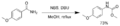 Hofmann rearrangement with NBS


Medical Disclaimer: WikiMD is for informational purposes only and is not a substitute for professional medical advice. Content may be inaccurate or outdated and should not be used for diagnosis or treatment. Always consult your healthcare provider for medical decisions. Verify information with trusted sources such as CDC.gov and NIH.gov. By using this site, you agree that WikiMD is not liable for any outcomes related to its content. See full disclaimer.
Credits:Most images are courtesy of Wikimedia commons, and templates, categories Wikipedia, licensed under CC BY SA or similar.
Translate page: - East Asian
中文,
日本,
한국어,
South Asian
हिन्दी,
தமிழ்,
తెలుగు,
Urdu,
ಕನ್ನಡ,
Southeast Asian
Indonesian,
Vietnamese,
Thai,
မြန်မာဘာသာ,
বাংলা
European
español,
Deutsch,
français,
Greek,
português do Brasil,
polski,
română,
русский,
Nederlands,
norsk,
svenska,
suomi,
Italian
Middle Eastern & African
عربى,
Turkish,
Persian,
Hebrew,
Afrikaans,
isiZulu,
Kiswahili,
Other
Bulgarian,
Hungarian,
Czech,
Swedish,
മലയാളം,
मराठी,
ਪੰਜਾਬੀ,
ગુજરાતી,
Portuguese,
Ukrainian

