Henrietta Lacks
Henrietta Lacks (born Loretta Pleasant; August 1, 1920 – October 4, 1951) was an African-American woman whose cancer cells led to significant medical advancements. Her cells are the source of the HeLa cell line, the first immortalized human cell line and one of the most vital cell lines in medical research.
Early Life and Background[edit]
Henrietta Lacks was born on August 1, 1920, in Roanoke, Virginia, to Eliza and Johnny Pleasant. Her family was poor, and she spent most of her early life in Clover, Virginia. She married David "Day" Lacks in 1941, and they had five children together.
Health Challenges and HeLa Cell Line[edit]
In 1951, Lacks was diagnosed with cervical cancer, and during treatment at Johns Hopkins Hospital, a sample of her cancer cells was taken without her knowledge or consent. These cells became the HeLa cell line. Unlike most cells, which die within a few days, Lacks' cells reproduced indefinitely under specific conditions, making them "immortal."[1]
This immortality and the rapid reproduction of the HeLa cell line made it invaluable to medical research. The cells have been used in the development of the polio vaccine, cloning, gene mapping, in vitro fertilization, and more.
Ethical Controversy[edit]
The use of Lacks' cells without her or her family's consent has sparked significant ethical controversy and changes in medical consent practices. The Lacks family was not aware of the cell line's existence until 20 years after her death. Despite the vast amount of wealth generated by the HeLa cell line, the Lacks family has not received any financial compensation.[2]
Legacy[edit]
Despite the controversy, Lacks' unwitting contribution to science has been invaluable. The HeLa cell line continues to be a vital resource in medical and biological research. Lacks' life and the impact of her cells have been the subject of numerous books and documentaries, including the best-selling book "The Immortal Life of Henrietta Lacks" by Rebecca Skloot.
Related pages[edit]
References[edit]

This WikiMD article can only be edited by registered and verified editors. You can log in or register.
-
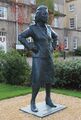 Henrietta Lacks statue, Bristol, RHS


Medical Disclaimer: WikiMD is for informational purposes only and is not a substitute for professional medical advice. Content may be inaccurate or outdated and should not be used for diagnosis or treatment. Always consult your healthcare provider for medical decisions. Verify information with trusted sources such as CDC.gov and NIH.gov. By using this site, you agree that WikiMD is not liable for any outcomes related to its content. See full disclaimer.
Credits:Most images are courtesy of Wikimedia commons, and templates, categories Wikipedia, licensed under CC BY SA or similar.
Translate page: - East Asian
中文,
日本,
한국어,
South Asian
हिन्दी,
தமிழ்,
తెలుగు,
Urdu,
ಕನ್ನಡ,
Southeast Asian
Indonesian,
Vietnamese,
Thai,
မြန်မာဘာသာ,
বাংলা
European
español,
Deutsch,
français,
Greek,
português do Brasil,
polski,
română,
русский,
Nederlands,
norsk,
svenska,
suomi,
Italian
Middle Eastern & African
عربى,
Turkish,
Persian,
Hebrew,
Afrikaans,
isiZulu,
Kiswahili,
Other
Bulgarian,
Hungarian,
Czech,
Swedish,
മലയാളം,
मराठी,
ਪੰਜਾਬੀ,
ગુજરાતી,
Portuguese,
Ukrainian

