Harry Raymond Eastlack
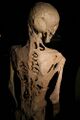
Harry Raymond Eastlack (1933–1973) was an individual known for his rare condition, fibrodysplasia ossificans progressiva (FOP), a disorder that causes fibrous tissue to ossify and become bone. Eastlack's case has been instrumental in the study of FOP, providing valuable insights into the disease's progression and potential treatments.
Early Life[edit]
Harry Raymond Eastlack was born on November 17, 1933. Little is known about his early life before his diagnosis with FOP. The condition typically begins in childhood, with symptoms such as painful swellings that eventually harden into bone.
Condition and Diagnosis[edit]
Fibrodysplasia ossificans progressiva is a rare and disabling genetic condition characterized by the abnormal development of bone in areas of the body where bone is not usually present, such as the muscles, tendons, and other connective tissues. The condition is caused by a mutation in the ACVR1 gene, which affects the body's repair mechanism, causing fibrous tissue to be ossified.
Eastlack began to show symptoms of FOP in his early childhood, but the rarity and complexity of the disease made it difficult to diagnose at the time. His condition progressively worsened, leading to significant physical limitations.
Contribution to Science[edit]
Despite the challenges posed by his condition, Eastlack made a significant contribution to medical science. Before his death, he expressed his wish to donate his body to research, hoping that it would help in finding a cure for FOP. Following his death on November 11, 1973, just days before his 40th birthday, his skeleton was preserved and is now housed at the Mütter Museum in Philadelphia. It remains one of the few complete skeletons of an individual with FOP and serves as a crucial resource for researchers studying the disease.
Legacy[edit]
Harry Raymond Eastlack's legacy lives on through the ongoing research into FOP. His contribution has not only advanced the understanding of this rare condition but also highlighted the importance of patient contributions to medical research. The Harry Eastlack case has become a cornerstone in the study of FOP, providing invaluable insights that continue to inform the development of potential treatments and therapies.
See Also[edit]
NIH genetic and rare disease info[edit]
Harry Raymond Eastlack is a rare disease.
| Rare and genetic diseases | ||||||
|---|---|---|---|---|---|---|
|
Rare diseases - Harry Raymond Eastlack
|
Harry_Raymond_Eastlack[edit]
-
 Fibrodysplasia ossificans progressiva


Medical Disclaimer: WikiMD is for informational purposes only and is not a substitute for professional medical advice. Content may be inaccurate or outdated and should not be used for diagnosis or treatment. Always consult your healthcare provider for medical decisions. Verify information with trusted sources such as CDC.gov and NIH.gov. By using this site, you agree that WikiMD is not liable for any outcomes related to its content. See full disclaimer.
Credits:Most images are courtesy of Wikimedia commons, and templates, categories Wikipedia, licensed under CC BY SA or similar.
Translate page: - East Asian
中文,
日本,
한국어,
South Asian
हिन्दी,
தமிழ்,
తెలుగు,
Urdu,
ಕನ್ನಡ,
Southeast Asian
Indonesian,
Vietnamese,
Thai,
မြန်မာဘာသာ,
বাংলা
European
español,
Deutsch,
français,
Greek,
português do Brasil,
polski,
română,
русский,
Nederlands,
norsk,
svenska,
suomi,
Italian
Middle Eastern & African
عربى,
Turkish,
Persian,
Hebrew,
Afrikaans,
isiZulu,
Kiswahili,
Other
Bulgarian,
Hungarian,
Czech,
Swedish,
മലയാളം,
मराठी,
ਪੰਜਾਬੀ,
ગુજરાતી,
Portuguese,
Ukrainian

