HIV integration
HIV Integration is a crucial step in the life cycle of the Human Immunodeficiency Virus (HIV). This process involves the insertion of the viral DNA into the host cell's genome, which allows the virus to replicate and spread throughout the body.
Overview[edit]
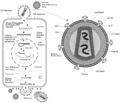
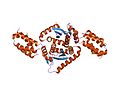
HIV integration is facilitated by the viral enzyme integrase. After the virus enters a host cell, it uses its reverse transcriptase enzyme to convert its RNA into DNA. The newly formed viral DNA then interacts with the host cell's DNA, guided by the integrase enzyme. This results in the integration of the viral DNA into the host cell's genome, which allows the virus to use the host cell's machinery to replicate itself.
Mechanism[edit]
The mechanism of HIV integration involves several steps:
- Viral Entry: The HIV virus binds to the CD4 receptor and a co-receptor (either CCR5 or CXCR4) on the surface of the host cell, facilitating its entry into the cell.
- Reverse Transcription: Once inside the cell, the virus uses its reverse transcriptase enzyme to convert its RNA into DNA.
- Integration: The viral DNA is then integrated into the host cell's genome with the help of the integrase enzyme. This process is known as HIV integration.
Clinical Significance[edit]
HIV integration is a key target for antiretroviral therapy (ART). Drugs that inhibit the integrase enzyme, known as integrase inhibitors, can prevent the integration of the viral DNA into the host cell's genome, thereby stopping the replication of the virus. Examples of integrase inhibitors include raltegravir, elvitegravir, and dolutegravir.
See Also[edit]
References[edit]

This WikiMD article can only be edited by registered and verified editors. You can log in or register.
-
 HIV integration
 -
 HIV integration
 -
 HIV integration
 -
 HIV integration
 -
 HIV integration


Medical Disclaimer: WikiMD is for informational purposes only and is not a substitute for professional medical advice. Content may be inaccurate or outdated and should not be used for diagnosis or treatment. Always consult your healthcare provider for medical decisions. Verify information with trusted sources such as CDC.gov and NIH.gov. By using this site, you agree that WikiMD is not liable for any outcomes related to its content. See full disclaimer.
Credits:Most images are courtesy of Wikimedia commons, and templates, categories Wikipedia, licensed under CC BY SA or similar.
Translate page: - East Asian
中文,
日本,
한국어,
South Asian
हिन्दी,
தமிழ்,
తెలుగు,
Urdu,
ಕನ್ನಡ,
Southeast Asian
Indonesian,
Vietnamese,
Thai,
မြန်မာဘာသာ,
বাংলা
European
español,
Deutsch,
français,
Greek,
português do Brasil,
polski,
română,
русский,
Nederlands,
norsk,
svenska,
suomi,
Italian
Middle Eastern & African
عربى,
Turkish,
Persian,
Hebrew,
Afrikaans,
isiZulu,
Kiswahili,
Other
Bulgarian,
Hungarian,
Czech,
Swedish,
മലയാളം,
मराठी,
ਪੰਜਾਬੀ,
ગુજરાતી,
Portuguese,
Ukrainian

