Greater petrosal nerve
The Greater Petrosal Nerve is a nerve in the human body that is part of the facial nerve system. It is responsible for carrying parasympathetic fibers to the lacrimal gland, as well as to the mucous membranes of the nasal cavity and palate.
Anatomy[edit]
The Greater Petrosal Nerve originates from the facial nerve in the facial canal, just after the nerve's geniculate ganglion. It then travels through the petrous part of the temporal bone, exiting through the greater petrosal foramen to enter the middle cranial fossa.
Function[edit]
The Greater Petrosal Nerve carries parasympathetic fibers that stimulate the secretion of tears from the lacrimal gland. It also carries fibers that stimulate the secretion of mucus from the mucous membranes of the nasal cavity and palate. In addition, it carries taste fibers from the palate.
Clinical Significance[edit]
Damage to the Greater Petrosal Nerve can result in a variety of symptoms, including dry eye syndrome, due to a lack of tear production, and loss of taste on the anterior two-thirds of the tongue. It can also lead to dry mouth and difficulty swallowing due to reduced salivation.
See Also[edit]
References[edit]

 | This medical article is a stub. You can help WikiMD by expanding the page. |
-
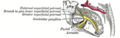 Greater petrosal nerve
 -
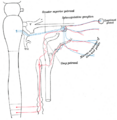 Greater petrosal nerve
 -
Greater petrosal nerve
-
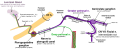 Greater petrosal nerve


.svg)

Medical Disclaimer: WikiMD is for informational purposes only and is not a substitute for professional medical advice. Content may be inaccurate or outdated and should not be used for diagnosis or treatment. Always consult your healthcare provider for medical decisions. Verify information with trusted sources such as CDC.gov and NIH.gov. By using this site, you agree that WikiMD is not liable for any outcomes related to its content. See full disclaimer.
Credits:Most images are courtesy of Wikimedia commons, and templates, categories Wikipedia, licensed under CC BY SA or similar.
Translate page: - East Asian
中文,
日本,
한국어,
South Asian
हिन्दी,
தமிழ்,
తెలుగు,
Urdu,
ಕನ್ನಡ,
Southeast Asian
Indonesian,
Vietnamese,
Thai,
မြန်မာဘာသာ,
বাংলা
European
español,
Deutsch,
français,
Greek,
português do Brasil,
polski,
română,
русский,
Nederlands,
norsk,
svenska,
suomi,
Italian
Middle Eastern & African
عربى,
Turkish,
Persian,
Hebrew,
Afrikaans,
isiZulu,
Kiswahili,
Other
Bulgarian,
Hungarian,
Czech,
Swedish,
മലയാളം,
मराठी,
ਪੰਜਾਬੀ,
ગુજરાતી,
Portuguese,
Ukrainian


