Great vessels
Great vessels are the large arteries and veins that directly connect to the heart. They include the superior vena cava, inferior vena cava, pulmonary artery, pulmonary veins, and the aorta. The term "great vessels" is derived from the Latin vasa magna.
Etymology[edit]
The term "great vessels" is a direct translation of the Latin term vasa magna. The word vasa means "vessels" and magna means "great". This term is used to describe the large blood vessels that directly connect to the heart.
Structure[edit]
The great vessels consist of the following:
- Superior vena cava: This large vein carries deoxygenated blood from the upper half of the body to the heart's right atrium.
- Inferior vena cava: This is the largest vein in the human body. It carries deoxygenated blood from the lower half of the body to the heart's right atrium.
- Pulmonary artery: This artery carries deoxygenated blood from the right ventricle to the lungs for oxygenation.
- Pulmonary veins: These veins carry oxygenated blood from the lungs to the left atrium of the heart.
- Aorta: This is the main and largest artery in the human body, originating from the left ventricle of the heart and extending down to the abdomen.
Function[edit]
The great vessels are responsible for the transportation of blood to and from the heart. They play a crucial role in the circulatory system, allowing for the distribution of oxygenated blood to the body and the return of deoxygenated blood back to the heart.
Related terms[edit]
- Artery: A blood vessel that carries blood away from the heart.
- Vein: A blood vessel that carries blood towards the heart.
- Heart: The organ that pumps blood throughout the body.
- Circulatory system: The system that circulates blood and lymph through the body.

This WikiMD article can only be edited by registered and verified editors. You can log in or register.
-
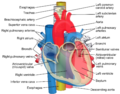 Relations of the aorta, trachea, esophagus, and other heart structures


Medical Disclaimer: WikiMD is for informational purposes only and is not a substitute for professional medical advice. Content may be inaccurate or outdated and should not be used for diagnosis or treatment. Always consult your healthcare provider for medical decisions. Verify information with trusted sources such as CDC.gov and NIH.gov. By using this site, you agree that WikiMD is not liable for any outcomes related to its content. See full disclaimer.
Credits:Most images are courtesy of Wikimedia commons, and templates, categories Wikipedia, licensed under CC BY SA or similar.
Translate page: - East Asian
中文,
日本,
한국어,
South Asian
हिन्दी,
தமிழ்,
తెలుగు,
Urdu,
ಕನ್ನಡ,
Southeast Asian
Indonesian,
Vietnamese,
Thai,
မြန်မာဘာသာ,
বাংলা
European
español,
Deutsch,
français,
Greek,
português do Brasil,
polski,
română,
русский,
Nederlands,
norsk,
svenska,
suomi,
Italian
Middle Eastern & African
عربى,
Turkish,
Persian,
Hebrew,
Afrikaans,
isiZulu,
Kiswahili,
Other
Bulgarian,
Hungarian,
Czech,
Swedish,
മലയാളം,
मराठी,
ਪੰਜਾਬੀ,
ગુજરાતી,
Portuguese,
Ukrainian

