Luck
Luck is a concept in philosophy, religion, and psychology that involves chance or fortune. It can be positive or negative, and is often associated with events that are outside of one's control. Luck can also be a belief in an organization of fortunate and unfortunate events.
Definition[edit]
Luck is a way of understanding a personal chance event. Luck has three aspects which are:
- Regarded as a probability affecting an individual or a group.
- The positive or negative aspect of events happening to a person.
- The interpretation of events in a positive, negative, or neutral fashion.
Cultural views[edit]
Different cultures have various views on luck. In Western culture, luck is often seen as a random event, while in many East Asian cultures, luck can be influenced by actions and rituals.
Western culture[edit]
In Western culture, luck is a random event. It is a common belief that luck derives from specific physical objects or actions, such as a lucky charm or a specific ritual. Some people believe that luck can be influenced through spiritual or mystical practices, such as prayer or divination.
Eastern culture[edit]
In many East Asian cultures, luck is not seen as purely random, but can be influenced by one's actions. For example, in Chinese culture, luck is closely tied to feng shui, the arrangement of objects in one's environment to achieve harmony and balance.
Luck in religion[edit]
In many religions, luck is not a matter of random chance, but is guided by a higher power. For example, in Christianity, it is believed that all events are part of God's plan.
Luck in psychology[edit]
In psychology, people's perception of luck can influence their mental state and behavior. Some people may feel lucky after experiencing a series of good events, while others may feel unlucky after a series of bad events.
See also[edit]

This WikiMD article can only be edited by registered and verified editors. You can log in or register.
-
 Four-leaf clover
 -
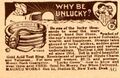 "Why Be Unlucky?" poster from 1926
 -
 Maneki neko with 7 Lucky Gods in Asakusa, Tokyo
 -
 Wheel of fortune
 -
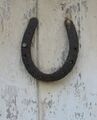 Horseshoe on door for luck
 -
 Barnstar


Medical Disclaimer: WikiMD is for informational purposes only and is not a substitute for professional medical advice. Content may be inaccurate or outdated and should not be used for diagnosis or treatment. Always consult your healthcare provider for medical decisions. Verify information with trusted sources such as CDC.gov and NIH.gov. By using this site, you agree that WikiMD is not liable for any outcomes related to its content. See full disclaimer.
Credits:Most images are courtesy of Wikimedia commons, and templates, categories Wikipedia, licensed under CC BY SA or similar.
Translate page: - East Asian
中文,
日本,
한국어,
South Asian
हिन्दी,
தமிழ்,
తెలుగు,
Urdu,
ಕನ್ನಡ,
Southeast Asian
Indonesian,
Vietnamese,
Thai,
မြန်မာဘာသာ,
বাংলা
European
español,
Deutsch,
français,
Greek,
português do Brasil,
polski,
română,
русский,
Nederlands,
norsk,
svenska,
suomi,
Italian
Middle Eastern & African
عربى,
Turkish,
Persian,
Hebrew,
Afrikaans,
isiZulu,
Kiswahili,
Other
Bulgarian,
Hungarian,
Czech,
Swedish,
മലയാളം,
मराठी,
ਪੰਜਾਬੀ,
ગુજરાતી,
Portuguese,
Ukrainian

