Golgi's method
Golgi's method is a histological technique developed by Italian physician and scientist Camillo Golgi in the late 19th century. It is used to visualize neurons and glial cells in the nervous system. The method involves impregnating tissue with a silver chromate solution, which selectively stains individual neurons in their entirety.
Etymology[edit]
The technique is named after its inventor, Camillo Golgi, who was a prominent Italian physician, pathologist, scientist, and Nobel laureate. He developed the method in 1873 while working in the University of Pavia.
Method[edit]
The Golgi method involves the use of a weak solution of potassium dichromate and silver nitrate to impregnate neural tissue. The silver chromate that is formed in the process is deposited in the cell body, dendrites, and axon of individual neurons, allowing them to be visualized under a light microscope.
The exact mechanism by which the Golgi method works is not fully understood. It is thought that the potassium dichromate fixes the tissue, while the silver nitrate impregnates the neurons. The method is known for its unpredictability, as it can randomly stain any cell in the tissue.
Applications[edit]
The Golgi method has been instrumental in advancing our understanding of the structure and organization of the nervous system. It was used by Santiago Ramón y Cajal, a Spanish histologist and Nobel laureate, to propose the neuron doctrine, which states that the neuron is the fundamental unit of the nervous system.
Despite its limitations, the Golgi method remains a valuable tool in neuroscience research. It is particularly useful for studying the morphology of neurons and the complex branching patterns of their dendrites and axons.
Related Terms[edit]

This WikiMD article can only be edited by registered and verified editors. You can log in or register.
-
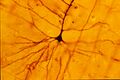 Golgi-stained pyramidal cell
 -
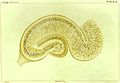 Golgi-stained hippocampus
 -
 Purkinje cell by Cajal


Medical Disclaimer: WikiMD is for informational purposes only and is not a substitute for professional medical advice. Content may be inaccurate or outdated and should not be used for diagnosis or treatment. Always consult your healthcare provider for medical decisions. Verify information with trusted sources such as CDC.gov and NIH.gov. By using this site, you agree that WikiMD is not liable for any outcomes related to its content. See full disclaimer.
Credits:Most images are courtesy of Wikimedia commons, and templates, categories Wikipedia, licensed under CC BY SA or similar.
Translate page: - East Asian
中文,
日本,
한국어,
South Asian
हिन्दी,
தமிழ்,
తెలుగు,
Urdu,
ಕನ್ನಡ,
Southeast Asian
Indonesian,
Vietnamese,
Thai,
မြန်မာဘာသာ,
বাংলা
European
español,
Deutsch,
français,
Greek,
português do Brasil,
polski,
română,
русский,
Nederlands,
norsk,
svenska,
suomi,
Italian
Middle Eastern & African
عربى,
Turkish,
Persian,
Hebrew,
Afrikaans,
isiZulu,
Kiswahili,
Other
Bulgarian,
Hungarian,
Czech,
Swedish,
മലയാളം,
मराठी,
ਪੰਜਾਬੀ,
ગુજરાતી,
Portuguese,
Ukrainian

