Gliotoxin
Gliotoxin is a mycotoxin that is produced by several species of fungi, including Aspergillus fumigatus, Aspergillus terreus, and Penicillium species. It is a member of the epipolythiodioxopiperazine (ETP) class of toxins, which are characterized by their highly reactive disulfide bridges. Gliotoxin has been found to have immunosuppressive properties, and it plays a role in the pathogenicity of A. fumigatus in invasive aspergillosis.
Structure and Biosynthesis[edit]
Gliotoxin is a small molecule with a complex structure that includes a disulfide bridge. This bridge is critical for its biological activity, as it allows the toxin to form reactive oxygen species and induce apoptosis in cells. The biosynthesis of gliotoxin involves a multi-step pathway that includes the formation of a dioxopiperazine ring and the addition of sulfur atoms to form the disulfide bridge.
Biological Activity[edit]
Gliotoxin has a wide range of biological activities, including immunosuppression, induction of apoptosis, and inhibition of DNA synthesis. It is thought to exert its immunosuppressive effects by inhibiting the function of macrophages and neutrophils, two types of immune cells. In addition, gliotoxin can induce apoptosis in a variety of cell types, including immune cells and endothelial cells. This ability to induce cell death may contribute to the pathogenicity of A. fumigatus in invasive aspergillosis.
Role in Disease[edit]
Gliotoxin is produced by A. fumigatus, a common cause of invasive aspergillosis in immunocompromised individuals. The toxin is thought to contribute to the pathogenicity of this fungus by suppressing the immune response and inducing cell death in the host. In addition, studies have shown that gliotoxin can enhance the virulence of A. fumigatus in animal models of invasive aspergillosis.
See Also[edit]
References[edit]
This mycotoxin-related article is a stub. You can help WikiMD by expanding it.
 | This medical article is a stub. You can help WikiMD by expanding the page. |
-
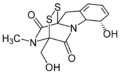 Gliotoxin
 -
Gliotoxin Biosynthesis Scheme
-
Gliotoxin Synthesis


Medical Disclaimer: WikiMD is for informational purposes only and is not a substitute for professional medical advice. Content may be inaccurate or outdated and should not be used for diagnosis or treatment. Always consult your healthcare provider for medical decisions. Verify information with trusted sources such as CDC.gov and NIH.gov. By using this site, you agree that WikiMD is not liable for any outcomes related to its content. See full disclaimer.
Credits:Most images are courtesy of Wikimedia commons, and templates, categories Wikipedia, licensed under CC BY SA or similar.
Translate page: - East Asian
中文,
日本,
한국어,
South Asian
हिन्दी,
தமிழ்,
తెలుగు,
Urdu,
ಕನ್ನಡ,
Southeast Asian
Indonesian,
Vietnamese,
Thai,
မြန်မာဘာသာ,
বাংলা
European
español,
Deutsch,
français,
Greek,
português do Brasil,
polski,
română,
русский,
Nederlands,
norsk,
svenska,
suomi,
Italian
Middle Eastern & African
عربى,
Turkish,
Persian,
Hebrew,
Afrikaans,
isiZulu,
Kiswahili,
Other
Bulgarian,
Hungarian,
Czech,
Swedish,
മലയാളം,
मराठी,
ਪੰਜਾਬੀ,
ગુજરાતી,
Portuguese,
Ukrainian


