Glial fibrillary acidic protein
Glial Fibrillary Acidic Protein (GFAP) is a type of Intermediate filament protein that is encoded by the GFAP gene in humans. It is an integral component of the Cytoskeleton in Astrocytes, a type of Glial cell in the Central nervous system.
Structure[edit]
GFAP is a monomeric protein with a molecular weight of approximately 50 kDa. It is composed of a central alpha-helical rod domain flanked by non-alpha-helical head and tail domains. The rod domain is responsible for the assembly of GFAP into intermediate filaments, while the head and tail domains are thought to mediate interactions with other cellular components.
Function[edit]
GFAP is primarily expressed in astrocytes, where it plays a crucial role in maintaining the structural integrity of the cell and regulating many aspects of astrocyte function. It is involved in cell shape and motility, cell division, and the formation and maintenance of the Blood-brain barrier. In addition, GFAP has been implicated in the response to Neuroinflammation and injury, with its expression often upregulated in reactive astrocytes following damage to the CNS.
Clinical significance[edit]
Alterations in GFAP expression and function have been associated with a number of neurological disorders. Mutations in the GFAP gene can lead to Alexander disease, a rare and often fatal neurodegenerative disease characterized by the accumulation of abnormal GFAP aggregates, known as Rosenthal fibers, in astrocytes. Elevated levels of GFAP in the cerebrospinal fluid and blood have also been proposed as a biomarker for various conditions, including Traumatic brain injury, Stroke, and Alzheimer's disease.
See also[edit]
References[edit]
 | This neuroscience article is a stub. You can help WikiMD by expanding the page. |
-
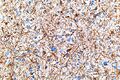 Anaplastic astrocytoma stained for GFAP at very high magnification
 -
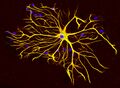 Astrocyte


Sponsored Health Resource

W8MD Weight Loss, Sleep & MedSpa
Looking for physician-supervised weight loss, semaglutide, tirzepatide, or GLP-1 receptor agonist options? W8MD helps eligible patients in New York City, Brooklyn, New Jersey, Connecticut, Pennsylvania, Delaware, and greater Philadelphia with medical weight loss, sleep medicine, and long-term maintenance support.
GLP-1 specials: Affordable GLP-1 injections NYC and Philadelphia starting from $29.99/week and up for semaglutide with insurance accepted for qualifying visits, and $45/week and up for tirzepatide with insurance accepted for qualifying visits. Self-pay options start from $59.99/week and up for semaglutide and $69.99/week and up for tirzepatide.
- Medical weight loss NYC
- Affordable GLP-1 injections NYC
- Budget GLP-1 weight loss shots Philadelphia
- New Jersey medical weight loss
- NYC medical weight loss blog
- Philadelphia weight loss blog
- Sleep medicine and sleep apnea services
- W8MD MedSpa and wellness
Book a W8MD appointment · View GLP-1 specials
Paid promotional message. Eligibility, pricing, insurance coverage, medication availability, and results vary. Medical evaluation required.

Medical Disclaimer: WikiMD is for informational purposes only and is not a substitute for professional medical advice. Content may be inaccurate or outdated and should not be used for diagnosis or treatment. Always consult your healthcare provider for medical decisions. Verify information with trusted sources such as CDC.gov and NIH.gov. By using this site, you agree that WikiMD is not liable for any outcomes related to its content. See full disclaimer.
Credits:Most images are courtesy of Wikimedia commons, and templates, categories Wikipedia, licensed under CC BY SA or similar.
Translate page: - East Asian
中文,
日本,
한국어,
South Asian
हिन्दी,
தமிழ்,
తెలుగు,
Urdu,
ಕನ್ನಡ,
Southeast Asian
Indonesian,
Vietnamese,
Thai,
မြန်မာဘာသာ,
বাংলা
European
español,
Deutsch,
français,
Greek,
português do Brasil,
polski,
română,
русский,
Nederlands,
norsk,
svenska,
suomi,
Italian
Middle Eastern & African
عربى,
Turkish,
Persian,
Hebrew,
Afrikaans,
isiZulu,
Kiswahili,
Other
Bulgarian,
Hungarian,
Czech,
Swedish,
മലയാളം,
मराठी,
ਪੰਜਾਬੀ,
ગુજરાતી,
Portuguese,
Ukrainian

