GTPase-activating protein
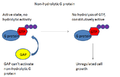
GTPase-activating protein (GAP) is a type of enzyme that regulates the activity of G proteins by increasing their rate of GTP hydrolysis. This process is crucial for the regulation of fundamental cellular processes such as signal transduction, cell division, and protein synthesis.
Function[edit]
GAPs function by binding to activated G proteins and stimulating their intrinsic GTPase activity, thereby accelerating the conversion of bound GTP to GDP. This results in the inactivation of the G protein and termination of the signaling event.
Types of GTPase-activating proteins[edit]
There are several types of GTPase-activating proteins, each with a specific set of target G proteins. These include:
- RhoGAP: These GAPs specifically target Rho family of G proteins, which are involved in regulating the cytoskeleton and cell migration.
- RasGAP: These GAPs target Ras subfamily of G proteins, which are involved in cell growth, differentiation, and survival.
- RabGAP: These GAPs target Rab family of G proteins, which are involved in vesicle trafficking.
Clinical significance[edit]
Mutations in GTPase-activating proteins have been implicated in several diseases, including cancer, neurological disorders, and cardiovascular diseases. For example, mutations in the NF1 gene, which encodes a RasGAP, are associated with Neurofibromatosis type I, a genetic disorder characterized by the growth of tumors along nerves in the skin, brain, and other parts of the body.
See also[edit]
References[edit]
 | This enzyme-related article is a stub. You can help WikiMD by expanding the page. |
```
-
 GTPase-activating protein
 -
 GTPase-activating protein
 -
 GTPase-activating protein
 -
 GTPase-activating protein
 -
 GTPase-activating protein


Advertise on WikiMD — 81,000+ full articles, ~900,000 total pages, ~250 million page views. Global reach, limited time promotional rates from $1/page/day. Learn more · View stats

Medical Disclaimer: WikiMD is for informational purposes only and is not a substitute for professional medical advice. Content may be inaccurate or outdated and should not be used for diagnosis or treatment. Always consult your healthcare provider for medical decisions. Verify information with trusted sources such as CDC.gov and NIH.gov. By using this site, you agree that WikiMD is not liable for any outcomes related to its content. See full disclaimer.
Credits:Most images are courtesy of Wikimedia commons, and templates, categories Wikipedia, licensed under CC BY SA or similar.
Translate page: - East Asian
中文,
日本,
한국어,
South Asian
हिन्दी,
தமிழ்,
తెలుగు,
Urdu,
ಕನ್ನಡ,
Southeast Asian
Indonesian,
Vietnamese,
Thai,
မြန်မာဘာသာ,
বাংলা
European
español,
Deutsch,
français,
Greek,
português do Brasil,
polski,
română,
русский,
Nederlands,
norsk,
svenska,
suomi,
Italian
Middle Eastern & African
عربى,
Turkish,
Persian,
Hebrew,
Afrikaans,
isiZulu,
Kiswahili,
Other
Bulgarian,
Hungarian,
Czech,
Swedish,
മലയാളം,
मराठी,
ਪੰਜਾਬੀ,
ગુજરાતી,
Portuguese,
Ukrainian

