Fusion power
Fusion power is a proposed form of power generation that would generate electricity by using heat from nuclear fusion reactions. In a fusion process, two lighter atomic nuclei combine to form a heavier nucleus, while releasing energy. Devices designed to harness this energy are known as fusion reactors.
Fusion reactions[edit]
The fusion of two nuclei with lower masses than iron (which, along with its lighter isotopes, has the largest binding energy per nucleon) generally releases energy, while the fusion of nuclei heavier than iron absorbs energy. The opposite is true for the reverse process, nuclear fission. This means that fusion generally occurs for lighter elements only, and likewise, that fission normally occurs only for heavier elements. There are extreme astrophysical events that can lead to short periods of fusion with heavier nuclei. This is the process that powers stars, including the Sun, and stellar nucleosynthesis generally results in the net creation of elements with more protons than iron.
Fusion power plants[edit]
A fusion power plant would have numerous benefits over current fission plants. Fusion releases no greenhouse gases. The fuel supply—primarily deuterium and lithium—is abundant and virtually inexhaustible. And while a meltdown is not possible in a fusion reactor, the process does produce high-energy neutrons.
Challenges[edit]
Despite the vast potential of fusion power, it has proven difficult to achieve. The main challenge is to sustain the fusion reaction, which requires temperatures of millions of degrees. At these temperatures, matter is in the plasma state. Containing and controlling this plasma long enough to extract useful power is a major technical challenge.
Current research[edit]
Several research projects are underway to overcome these challenges. The largest and most well-known of these is the ITER project, an international collaboration aiming to build a prototype fusion power plant. Other projects include the National Ignition Facility in the United States, and the Joint European Torus in the UK.
See also[edit]
 | This article about energy, its collection, its distribution, or its uses is a stub. You can help WikiMD by expanding the page. |
Fusion power gallery[edit]
-
 Scylla I in 1958
 -
 Tokamak T-1
 -
 JET cutaway drawing 1980
 -
 PFRC 2 pulse
 -
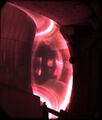 EAST Tokamak plasma image
 -
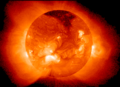 Sun in X-Ray
 -
 Binding energy curve - common isotopes
 -
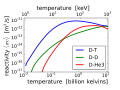 Fusion reaction rate
 -
 Fusion Triples 2021
 -
 Chart of Fusion Approaches


Medical Disclaimer: WikiMD is for informational purposes only and is not a substitute for professional medical advice. Content may be inaccurate or outdated and should not be used for diagnosis or treatment. Always consult your healthcare provider for medical decisions. Verify information with trusted sources such as CDC.gov and NIH.gov. By using this site, you agree that WikiMD is not liable for any outcomes related to its content. See full disclaimer.
Credits:Most images are courtesy of Wikimedia commons, and templates, categories Wikipedia, licensed under CC BY SA or similar.
Translate page: - East Asian
中文,
日本,
한국어,
South Asian
हिन्दी,
தமிழ்,
తెలుగు,
Urdu,
ಕನ್ನಡ,
Southeast Asian
Indonesian,
Vietnamese,
Thai,
မြန်မာဘာသာ,
বাংলা
European
español,
Deutsch,
français,
Greek,
português do Brasil,
polski,
română,
русский,
Nederlands,
norsk,
svenska,
suomi,
Italian
Middle Eastern & African
عربى,
Turkish,
Persian,
Hebrew,
Afrikaans,
isiZulu,
Kiswahili,
Other
Bulgarian,
Hungarian,
Czech,
Swedish,
മലയാളം,
मराठी,
ਪੰਜਾਬੀ,
ગુજરાતી,
Portuguese,
Ukrainian

