Foot and ankle surgery
Foot and ankle surgery is a specialized branch of orthopedic surgery and podiatric surgery that deals with the diagnosis, treatment, and prevention of disorders of the foot and ankle. This field encompasses a wide range of procedures from minor bunion corrections to complex reconstructions. Foot and ankle surgeons are trained to address a variety of conditions including, but not limited to, fractures, arthritis, deformities, and injuries.
Types of Foot and Ankle Surgery[edit]
Foot and ankle surgeries can be broadly categorized into several types, including:
- Reconstructive Surgery: This type of surgery is performed to correct deformities caused by birth defects, injuries, or degenerative diseases. Common procedures include ankle arthrodesis (fusion) and osteotomy (bone cutting) to realign bones.
- Trauma Surgery: Focuses on repairing structures damaged by traumatic injuries such as fractures and ligament tears. An example is the surgical fixation of an ankle fracture.
- Arthroscopy: A minimally invasive procedure used to diagnose and treat joint problems. During arthroscopy, a small camera and instruments are inserted through tiny incisions, allowing the surgeon to repair damaged tissue.
- Bunion and Toe Surgery: Procedures to correct bunions and other toe deformities, such as hammer toe surgery, are common. These surgeries aim to relieve pain and improve foot function.
- Nerve Surgery: Addresses conditions like neuromas and tarsal tunnel syndrome, which involve nerve compression.
Common Conditions Treated[edit]
Foot and ankle surgeons treat a wide range of conditions, including:
- Arthritis: Including osteoarthritis, rheumatoid arthritis, and post-traumatic arthritis.
- Fractures and sprains: Injuries to bones and ligaments.
- Deformities: Such as bunions, hammer toes, and flat feet.
- Tendon disorders: Including Achilles tendonitis and peroneal tendonitis.
- Diabetic foot care: Management of foot problems related to diabetes, such as ulcers and infections.
Preparation for Surgery[edit]
Preparation for foot and ankle surgery may involve several steps, including:
- Comprehensive medical evaluation to assess overall health and identify any conditions that could complicate surgery.
- Imaging tests, such as X-rays, MRI, or CT scans, to provide detailed pictures of the foot and ankle.
- Discussion of potential risks and benefits of the surgery.
- Instructions on pre-operative and post-operative care.
Recovery and Rehabilitation[edit]
Recovery from foot and ankle surgery varies depending on the procedure and individual patient factors. Rehabilitation plays a crucial role in achieving the best possible outcome. This may include:
- Physical therapy to restore strength, flexibility, and function.
- Gradual return to weight-bearing activities as advised by the surgeon.
- Use of orthotic devices or supportive footwear to aid in recovery.
Choosing a Surgeon[edit]
When considering foot and ankle surgery, it is important to choose a surgeon with specialized training and experience in the specific procedure. Board certification in orthopedic or podiatric surgery, with additional fellowship training in foot and ankle surgery, is highly recommended.
Conclusion[edit]
Foot and ankle surgery offers effective treatment options for a wide range of conditions affecting the lower extremities. With advances in surgical techniques, many patients experience significant pain relief and improved quality of life. However, careful consideration and preparation are essential to ensure the best possible outcomes.
 | This medical article is a stub. You can help WikiMD by expanding the page. |
-
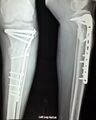 X-ray showing internal fixation of a leg fracture

Advertise on WikiMD — 81,000+ full articles, ~900,000 total pages, ~250 million page views. Global reach, limited time promotional rates from $1/page/day. Learn more · View stats

Translate page: - East Asian
中文,
日本,
한국어,
South Asian
हिन्दी,
தமிழ்,
తెలుగు,
Urdu,
ಕನ್ನಡ,
Southeast Asian
Indonesian,
Vietnamese,
Thai,
မြန်မာဘာသာ,
বাংলা
European
español,
Deutsch,
français,
Greek,
português do Brasil,
polski,
română,
русский,
Nederlands,
norsk,
svenska,
suomi,
Italian
Middle Eastern & African
عربى,
Turkish,
Persian,
Hebrew,
Afrikaans,
isiZulu,
Kiswahili,
Other
Bulgarian,
Hungarian,
Czech,
Swedish,
മലയാളം,
मराठी,
ਪੰਜਾਬੀ,
ગુજરાતી,
Portuguese,
Ukrainian
About WikiMD • Contact • Disclaimer • Privacy • Copyright • Site statistics
Some content and images may originate from Wikimedia Commons or Wikipedia and remain subject to their stated licenses. Unless otherwise noted, eligible WikiMD content is available under CC BY-SA 4.0.
WikiMD Wellnesspedia — Free health & wellness information for patients, students, and health professionals.

