Extraglomerular mesangial cell
The Extraglomerular mesangial cell (also known as Lacis cell or Polkissen cell) is a type of cell located in the kidney. These cells are part of the juxtaglomerular apparatus and are found outside the glomerulus, hence the name 'extraglomerular'.
Etymology[edit]
The term 'extraglomerular' is derived from the Latin words 'extra' meaning 'outside' and 'glomerulus' referring to a small ball. 'Mesangial' comes from the Greek words 'mesos' meaning 'middle' and 'angeion' meaning 'vessel'.
Function[edit]
Extraglomerular mesangial cells are involved in the regulation of blood pressure and the filtration rate of the glomerulus. They are thought to communicate with both the afferent arteriole and efferent arteriole, and may play a role in the feedback mechanisms that regulate glomerular filtration rate (GFR).
Related Terms[edit]
- Juxtaglomerular apparatus: A system of specialized cells in the kidneys that helps to regulate blood pressure and the filtration rate of the kidneys.
- Glomerulus: A network of tiny blood vessels in the kidney where the filtration of blood takes place.
- Afferent arteriole: The small artery that carries blood toward the glomerulus.
- Efferent arteriole: The small artery that carries blood away from the glomerulus.
See Also[edit]

This WikiMD article can only be edited by registered and verified editors. You can log in or register.
Extraglomerular_mesangial_cell[edit]
-
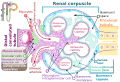 Renal corpuscle diagram


Medical Disclaimer: WikiMD is for informational purposes only and is not a substitute for professional medical advice. Content may be inaccurate or outdated and should not be used for diagnosis or treatment. Always consult your healthcare provider for medical decisions. Verify information with trusted sources such as CDC.gov and NIH.gov. By using this site, you agree that WikiMD is not liable for any outcomes related to its content. See full disclaimer.
Credits:Most images are courtesy of Wikimedia commons, and templates, categories Wikipedia, licensed under CC BY SA or similar.
Translate page: - East Asian
中文,
日本,
한국어,
South Asian
हिन्दी,
தமிழ்,
తెలుగు,
Urdu,
ಕನ್ನಡ,
Southeast Asian
Indonesian,
Vietnamese,
Thai,
မြန်မာဘာသာ,
বাংলা
European
español,
Deutsch,
français,
Greek,
português do Brasil,
polski,
română,
русский,
Nederlands,
norsk,
svenska,
suomi,
Italian
Middle Eastern & African
عربى,
Turkish,
Persian,
Hebrew,
Afrikaans,
isiZulu,
Kiswahili,
Other
Bulgarian,
Hungarian,
Czech,
Swedish,
മലയാളം,
मराठी,
ਪੰਜਾਬੀ,
ગુજરાતી,
Portuguese,
Ukrainian

