Eupomatia laurina
Species of flowering plant
Eupomatia laurina, commonly known as the Bolwarra, is a species of flowering plant in the family Eupomatiaceae. It is native to Australia, where it is found in rainforests and wet sclerophyll forests.
Description[edit]

Eupomatia laurina is a shrub or small tree that can grow up to 5 meters in height. The leaves are simple, alternate, and have a glossy appearance. They are elliptic to obovate in shape, measuring 5–15 cm long and 2–6 cm wide.
The flowers are solitary and terminal, with a diameter of 2–3 cm. They are creamy white and have a distinctive fragrance. The flowers lack true petals; instead, they have petal-like structures called tepals.
Distribution and habitat[edit]

Eupomatia laurina is found along the eastern coast of Australia, from Queensland to New South Wales. It grows in rainforests and wet sclerophyll forests, often in shaded areas.
Ecology[edit]

The flowers of Eupomatia laurina are pollinated by small beetles, particularly those of the family Curculionidae. The plant has a mutualistic relationship with these beetles, which are attracted to the flowers by their scent and feed on the pollen.
Uses[edit]

The fruit of Eupomatia laurina is edible and has been used by Indigenous Australians as a food source. The fruit is a berry, 1–2 cm in diameter, and contains numerous seeds.
Cultivation[edit]
Eupomatia laurina can be grown in gardens as an ornamental plant. It prefers a shaded position with well-drained soil and requires protection from frost.
Gallery[edit]
-
 Eupomatia laurina flower close-up
 -
 Eupomatia laurina foliage and flower
 -
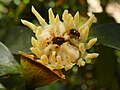 Eupomatia laurina with pollinating beetle


Related pages[edit]
Ad. Transform your life with W8MD's
GLP-1 weight loss injections special from $29.99 with insurance
|
WikiMD Medical Encyclopedia |
Medical Disclaimer: WikiMD is for informational purposes only and is not a substitute for professional medical advice. Content may be inaccurate or outdated and should not be used for diagnosis or treatment. Always consult your healthcare provider for medical decisions. Verify information with trusted sources such as CDC.gov and NIH.gov. By using this site, you agree that WikiMD is not liable for any outcomes related to its content. See full disclaimer.
Credits:Most images are courtesy of Wikimedia commons, and templates, categories Wikipedia, licensed under CC BY SA or similar.
Translate this page: - East Asian
中文,
日本,
한국어,
South Asian
हिन्दी,
தமிழ்,
తెలుగు,
Urdu,
ಕನ್ನಡ,
Southeast Asian
Indonesian,
Vietnamese,
Thai,
မြန်မာဘာသာ,
বাংলা
European
español,
Deutsch,
français,
Greek,
português do Brasil,
polski,
română,
русский,
Nederlands,
norsk,
svenska,
suomi,
Italian
Middle Eastern & African
عربى,
Turkish,
Persian,
Hebrew,
Afrikaans,
isiZulu,
Kiswahili,
Other
Bulgarian,
Hungarian,
Czech,
Swedish,
മലയാളം,
मराठी,
ਪੰਜਾਬੀ,
ગુજરાતી,
Portuguese,
Ukrainian
