Electrostatics
Electrostatics is a branch of physics that studies electric charges at rest. Since classical physics, it has been known that some materials such as amber attract lightweight particles after rubbing. The Greek word for amber, ήλεκτρον, or electron, was the source of the word 'electricity'. Electrostatic phenomena arise from the forces that electric charges exert on each other and are described by Coulomb's Law. Even though electrostatically induced forces seem to be rather weak, some electrostatic forces such as the one between an electron and a proton, that together make up a hydrogen atom, is about 36 orders of magnitude stronger than the gravitational force acting between them.
History[edit]
The study of electrostatics has a long history. In ancient Greece, the philosopher Thales of Miletus observed that amber could attract other objects when rubbed. This phenomenon was later named "electricity" after the Greek word for amber. In the 17th century, scientists such as William Gilbert and Robert Boyle conducted experiments to understand the properties of electric charge. In the 18th century, Benjamin Franklin conducted his famous kite experiment, demonstrating that lightning is a form of electricity.
Principles[edit]
Electrostatics involves the buildup of charge on the surface of objects due to contact with other surfaces. This is because certain objects can "donate" electrons, causing the object gaining electrons to become negatively charged, and the object losing electrons to become positively charged. The force of the charges on an object is described by Coulomb's Law, which states that like charges repel each other while opposite charges attract.
Applications[edit]
Electrostatics has many applications in everyday life and in various scientific fields. For example, it is used in photocopying, laser printing, and certain types of air filters. In medicine, electrostatics is used in technologies such as X-ray machines and defibrillators.
See also[edit]
References[edit]

This WikiMD article can only be edited by registered and verified editors. You can log in or register.
-
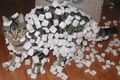 Cat demonstrating static cling with styrofoam peanuts
 -
 Electrostatic induction
 -
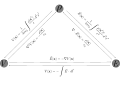 Electrostatics relation triangle


Sponsored Health Resource

W8MD Weight Loss, Sleep & MedSpa
Looking for physician-supervised weight loss, semaglutide, tirzepatide, or GLP-1 receptor agonist options? W8MD helps eligible patients in New York City, Brooklyn, New Jersey, Connecticut, Pennsylvania, Delaware, and greater Philadelphia with medical weight loss, sleep medicine, and long-term maintenance support.
GLP-1 specials: Affordable GLP-1 injections NYC and Philadelphia starting from $29.99/week and up for semaglutide with insurance accepted for qualifying visits, and $45/week and up for tirzepatide with insurance accepted for qualifying visits. Self-pay options start from $59.99/week and up for semaglutide and $69.99/week and up for tirzepatide.
- Medical weight loss NYC
- Affordable GLP-1 injections NYC
- Budget GLP-1 weight loss shots Philadelphia
- New Jersey medical weight loss
- NYC medical weight loss blog
- Philadelphia weight loss blog
- Sleep medicine and sleep apnea services
- W8MD MedSpa and wellness
Book a W8MD appointment · View GLP-1 specials
Paid promotional message. Eligibility, pricing, insurance coverage, medication availability, and results vary. Medical evaluation required.

Medical Disclaimer: WikiMD is for informational purposes only and is not a substitute for professional medical advice. Content may be inaccurate or outdated and should not be used for diagnosis or treatment. Always consult your healthcare provider for medical decisions. Verify information with trusted sources such as CDC.gov and NIH.gov. By using this site, you agree that WikiMD is not liable for any outcomes related to its content. See full disclaimer.
Credits:Most images are courtesy of Wikimedia commons, and templates, categories Wikipedia, licensed under CC BY SA or similar.
Translate page: - East Asian
中文,
日本,
한국어,
South Asian
हिन्दी,
தமிழ்,
తెలుగు,
Urdu,
ಕನ್ನಡ,
Southeast Asian
Indonesian,
Vietnamese,
Thai,
မြန်မာဘာသာ,
বাংলা
European
español,
Deutsch,
français,
Greek,
português do Brasil,
polski,
română,
русский,
Nederlands,
norsk,
svenska,
suomi,
Italian
Middle Eastern & African
عربى,
Turkish,
Persian,
Hebrew,
Afrikaans,
isiZulu,
Kiswahili,
Other
Bulgarian,
Hungarian,
Czech,
Swedish,
മലയാളം,
मराठी,
ਪੰਜਾਬੀ,
ગુજરાતી,
Portuguese,
Ukrainian

