Ebenaceae
Ebenaceae, commonly known as the ebony or persimmon family, is a family of flowering plants that includes a number of economically important and ecologically significant species. The family is most notable for its hardwood trees, which are prized for their dense, dark wood, as well as for its fruit-bearing species, such as the persimmon. This article provides an overview of the Ebenaceae family, including its taxonomy, distribution, ecology, and economic importance.
Taxonomy and Evolution[edit]
The Ebenaceae family belongs to the order Ebenales, and it is divided into several genera, the most well-known of which are Diospyros (which includes the persimmons) and Euclea. Diospyros is the largest genus within the family, encompassing over 700 species. The family has a wide distribution, with species found in tropical and subtropical regions of the world, including Africa, Asia, and the Americas.
Molecular phylogenetic studies have played a crucial role in understanding the evolutionary relationships within the Ebenaceae. These studies have helped clarify the classification of species within the family and have provided insights into the evolutionary history and biogeography of the Ebenaceae.
Distribution and Habitat[edit]
Species within the Ebenaceae family are found in a variety of habitats, ranging from tropical rainforests to arid deserts. They are most abundant in tropical regions, where they can be dominant components of the forest understory. In temperate zones, species of Diospyros are often cultivated for their fruit or as ornamental trees.
Ecology[edit]
Members of the Ebenaceae family play significant roles in their ecosystems. Many species are important as food sources for wildlife. For example, the fruits of various Diospyros species are consumed by birds, mammals, and insects. Additionally, the dense wood of ebony trees provides habitat and nesting sites for numerous species.
Economic Importance[edit]
The Ebenaceae family includes species of considerable economic value. The wood of ebony trees (Diospyros spp.) is highly valued for its hardness and fine grain, making it a preferred material for furniture, musical instruments, and decorative items. Persimmons (Diospyros spp.) are cultivated for their edible fruit, which is consumed fresh or used in various culinary preparations. Some species of Diospyros are also used in traditional medicine.
Conservation[edit]
Several species within the Ebenaceae family are threatened by habitat loss, overexploitation, and climate change. Conservation efforts are essential to protect these species from extinction. This includes habitat preservation, sustainable harvesting practices, and the establishment of protected areas.
See Also[edit]
References[edit]

-
 Diospyros sandwicensis
 -
 Diospyros chloroxylon in Hyderabad
 -
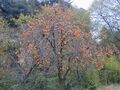 Plaqueminier et ses kakis
 -
 Royena graeca
 -
 Persimmon


Medical Disclaimer: WikiMD is for informational purposes only and is not a substitute for professional medical advice. Content may be inaccurate or outdated and should not be used for diagnosis or treatment. Always consult your healthcare provider for medical decisions. Verify information with trusted sources such as CDC.gov and NIH.gov. By using this site, you agree that WikiMD is not liable for any outcomes related to its content. See full disclaimer.
Credits:Most images are courtesy of Wikimedia commons, and templates, categories Wikipedia, licensed under CC BY SA or similar.
Translate page: - East Asian
中文,
日本,
한국어,
South Asian
हिन्दी,
தமிழ்,
తెలుగు,
Urdu,
ಕನ್ನಡ,
Southeast Asian
Indonesian,
Vietnamese,
Thai,
မြန်မာဘာသာ,
বাংলা
European
español,
Deutsch,
français,
Greek,
português do Brasil,
polski,
română,
русский,
Nederlands,
norsk,
svenska,
suomi,
Italian
Middle Eastern & African
عربى,
Turkish,
Persian,
Hebrew,
Afrikaans,
isiZulu,
Kiswahili,
Other
Bulgarian,
Hungarian,
Czech,
Swedish,
മലയാളം,
मराठी,
ਪੰਜਾਬੀ,
ગુજરાતી,
Portuguese,
Ukrainian

