Double bond
A double bond in chemistry is a chemical bond between two chemical elements involving four bonding electrons instead of the usual two. The most common double bond occurs between two carbon atoms and can be found in alkenes. Many types of double bonds exist between two different elements. For example, in a carbonyl group with a carbon atom and an oxygen atom. Other common double bonds are found in azo compounds (N=N), imines (C=N), sulfoxides (S=O), and peroxides (O=O). In ethene (ethylene), the double bond is the source of the compound's useful reactivity.
Structure and bonding[edit]
Double bonds are shorter than single bonds because p-orbital overlap is maximized. With regard to the bond order, double bonds are stronger than single bonds, but they are less stable. This increased strength and decreased stability can be explained in terms of electronic structure. In molecules with double bonds, p-orbital overlap creates bonding over a larger spatial volume than is available in a simple single bond. As a consequence, electrons in double bonds are more delocalized than in single bonds.
Double bonds in alkenes[edit]
The simplest example of a double bond is found in ethene (also known as ethylene, H2C=CH2). In ethene, the double bond is formed from the overlap of the sp2 orbitals of the two carbon atoms, and from the overlap of the p orbitals of the two carbon atoms.
Double bonds between different elements[edit]
Double bonds can also occur between different elements. One of the most common types of double bond is that found in carbonyl groups (C=O). Other common types of double bonds are those in azo compounds (N=N), imines (C=N), sulfoxides (S=O), and peroxides (O=O).
See also[edit]

This WikiMD article can only be edited by registered and verified editors. You can log in or register.
-
 Ethene structural formula
 -
 Leuckart-Wallach Reaction Acetone
 -
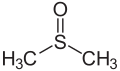 Dimethyl sulfoxide
 -
Trans-diazene 2D structure
-
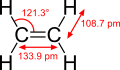 Ethylene CRC MW dimensions 2D
 -
Double bond
-
Double bond
-
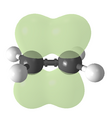 Ethylene 3D model


Medical Disclaimer: WikiMD is for informational purposes only and is not a substitute for professional medical advice. Content may be inaccurate or outdated and should not be used for diagnosis or treatment. Always consult your healthcare provider for medical decisions. Verify information with trusted sources such as CDC.gov and NIH.gov. By using this site, you agree that WikiMD is not liable for any outcomes related to its content. See full disclaimer.
Credits:Most images are courtesy of Wikimedia commons, and templates, categories Wikipedia, licensed under CC BY SA or similar.
Translate page: - East Asian
中文,
日本,
한국어,
South Asian
हिन्दी,
தமிழ்,
తెలుగు,
Urdu,
ಕನ್ನಡ,
Southeast Asian
Indonesian,
Vietnamese,
Thai,
မြန်မာဘာသာ,
বাংলা
European
español,
Deutsch,
français,
Greek,
português do Brasil,
polski,
română,
русский,
Nederlands,
norsk,
svenska,
suomi,
Italian
Middle Eastern & African
عربى,
Turkish,
Persian,
Hebrew,
Afrikaans,
isiZulu,
Kiswahili,
Other
Bulgarian,
Hungarian,
Czech,
Swedish,
മലയാളം,
मराठी,
ਪੰਜਾਬੀ,
ગુજરાતી,
Portuguese,
Ukrainian


