Dog sense of smell
Dog Sense of Smell
The dog's sense of smell is a highly evolved sensory ability that is vastly superior to that of humans. This remarkable sense allows dogs to detect odors at concentrations nearly 100 million times lower than humans can. The biological and anatomical adaptations that contribute to this extraordinary sense make dogs invaluable in various fields, including law enforcement, search and rescue, and medical diagnosis.
Anatomy of the Dog's Nose[edit]
The anatomy of a dog's nose is intricately designed to enhance its sense of smell. A dog's nose contains up to 300 million olfactory receptors, compared to about 6 million in humans. The olfactory bulb in dogs is also proportionally larger than in humans, accounting for a significant part of the dog's brain and further amplifying its ability to process scents.
The internal structure of a dog's nose includes a complex system of scroll-like bones called turbinates, which are covered in a moist, spongy tissue. This design maximizes the surface area within the nasal cavity, allowing for the absorption of more scent molecules. When air enters the nostrils, it is divided into two paths: one for olfaction and the other for respiration, ensuring that the analysis of smells is not interrupted by the need to breathe.
Function and Capabilities[edit]
Dogs use their sense of smell to interpret the world around them. This sense can detect not only the presence of a particular substance but also its direction and age. Dogs are capable of discerning individual components of a complex scent, which enables them to follow trails and identify specific individuals or objects.
The sensitivity of a dog's nose is such that it can detect a teaspoon of sugar in a million gallons of water, equivalent to two Olympic-sized swimming pools. This sensitivity is employed in various practical applications, such as detecting drugs, explosives, and even diseases in humans, such as cancer or the onset of an epileptic seizure.
Applications[edit]
The dog's sense of smell has been harnessed in numerous fields:
- Law Enforcement: Dogs are trained to detect drugs, explosives, and even the scent of a human body, aiding in criminal investigations and security checks.
- Search and Rescue: In disaster zones, dogs can locate survivors buried under rubble by detecting their scent.
- Medical Diagnosis: Some dogs are trained to sniff out diseases in humans, providing a non-invasive diagnostic method for conditions like cancer, diabetes, and COVID-19.
- Wildlife Conservation: Conservation dogs are used to locate scat samples for research on wildlife populations and health.
Training and Performance[edit]
Training a dog to utilize its sense of smell for specific tasks involves harnessing its natural instincts. Positive reinforcement techniques are commonly used, rewarding the dog for correctly identifying a target scent. The performance of scent-detection dogs can be affected by various factors, including the environment, the dog's health and age, and the complexity of the scent.
Conclusion[edit]
The dog's sense of smell is a remarkable natural phenomenon that has been adapted for a wide range of beneficial applications. Through a combination of anatomical specialization and training, dogs can perform tasks that are beyond human capabilities, making them invaluable partners in many aspects of society.
.png)
-
 Bloodhound sniffing the ground
 -
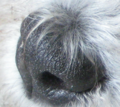 Close-up of a dog's nose


Ad. Transform your health with W8MD Weight Loss, Sleep & MedSpa

Tired of being overweight?
Get started with evidence based, physician-supervised
affordable GLP-1 weight loss injections
Now available in New York City and Philadelphia:
- Semaglutide starting from $59.99/week and up
- Tirzepatide starting from $69.99/week and up (dose dependent)
✔ Evidence-based medical weight loss ✔ Insurance-friendly visits available ✔ Same-week appointments, evenings & weekends
Learn more:
Start your transformation today with W8MD weight loss centers.
|
WikiMD Medical Encyclopedia |
Medical Disclaimer: WikiMD is for informational purposes only and is not a substitute for professional medical advice. Content may be inaccurate or outdated and should not be used for diagnosis or treatment. Always consult your healthcare provider for medical decisions. Verify information with trusted sources such as CDC.gov and NIH.gov. By using this site, you agree that WikiMD is not liable for any outcomes related to its content. See full disclaimer.
Credits:Most images are courtesy of Wikimedia commons, and templates, categories Wikipedia, licensed under CC BY SA or similar.
Translate this page: - East Asian
中文,
日本,
한국어,
South Asian
हिन्दी,
தமிழ்,
తెలుగు,
Urdu,
ಕನ್ನಡ,
Southeast Asian
Indonesian,
Vietnamese,
Thai,
မြန်မာဘာသာ,
বাংলা
European
español,
Deutsch,
français,
Greek,
português do Brasil,
polski,
română,
русский,
Nederlands,
norsk,
svenska,
suomi,
Italian
Middle Eastern & African
عربى,
Turkish,
Persian,
Hebrew,
Afrikaans,
isiZulu,
Kiswahili,
Other
Bulgarian,
Hungarian,
Czech,
Swedish,
മലയാളം,
मराठी,
ਪੰਜਾਬੀ,
ગુજરાતી,
Portuguese,
Ukrainian
